
porcelainflower (Hoya carnosa)
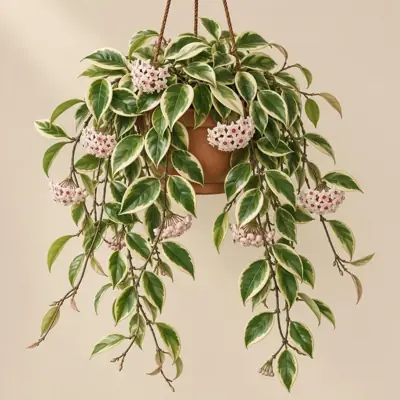
Hoya carnosa is an evergreen perennial vine with climbing and twining growth; it can grow epiphytically, climb, trail, and is suitable for hanging containers.
Watch: 21 Hoyas: Water Less, Wait Longer
Overview
Hoya carnosa is an evergreen perennial vine with climbing and twining growth; it can grow epiphytically, climb, trail, and is suitable for hanging containers.
Origin and habitat
Sources differ on the native range: it extends from Asia to Australia, with accounts including India, southern China, Taiwan, Japan, Southeast Asia, and Australia, while some also include Fiji. It can grow epiphytically on trees and also occurs on rocks, rocky sites near coasts, limestone sites, and in forests; stems can root at the nodes and climb tree trunks or rock surfaces. It is native to warm regions from Asia to Australia, and in cultivation it prefers warm, humid conditions and should be protected from frost.
Characteristics
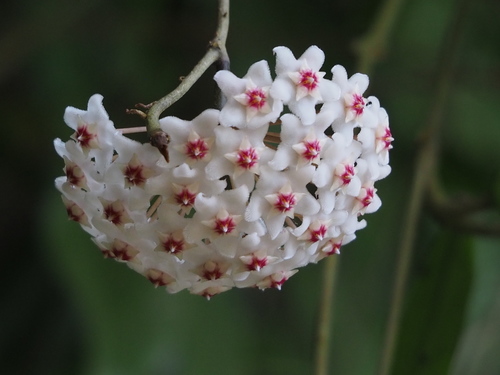
A single source reports a mature height of about 400–800 cm and a mature spread of about 100–150 cm, so sources are few for these measurements. Sources differ in their descriptions of the leaves, which are opposite, thick, fleshy, and glossy, with shapes ranging from broadly ovate and elliptic to ovate-oblong or nearly heart-shaped. Sources differ in their flower descriptions: the fragrant, waxy, star-shaped flowers are usually white to pale pink, with red or deeper pink centers, form dense umbel-like clusters, and can secrete sweet, sticky nectar. Flowering is mainly from spring through summer and may continue into late summer; the plant has vigorous growth, and its fruits are slender, spindle-shaped follicles.
Light
Sources differ on light requirements: bright indirect light, filtered light, and partial sun are described, while some sources also accept full sun or regular direct light; exposure to strong sun may cause the leaves to yellow.
Watering
Use a well-drained growing medium and allow it to dry somewhat between waterings; avoid prolonged wetness, and during the resting period the medium can become nearly dry. Conditions that are either too wet or too dry may cause leaf drop.
Humidity and airflow
Hoya carnosa prefers high humidity.
Temperature and dormancy
A single source reports a minimum temperature of about 5 °C, so sources are few for this value. A single source generally places it in a USDA hardiness range, while it is frost tender and should be kept above freezing.
Growing medium and mounting
The growing medium should be loose and fast-draining and may be rich in organic matter; it can also grow in well-drained loamy, sandy, or chalky soil across acidic, neutral, and alkaline conditions.
Feeding
It can be fertilized regularly during the growing season, with sources describing either slow-release fertilizer applied periodically or feeding at intervals during spring and summer.
Propagation
Hoya carnosa can be propagated mainly by stem cuttings and also by layering; cuttings can be rooted in growing medium or water.
Common problems
Potential pests include mealybugs, indoor fungus gnats, and banded greenhouse thrips. It is generally reported to have few disease problems. Excessively wet or dry growing medium may cause leaf drop, poor drainage or excessive wetness may cause root rot, and strong sun may cause leaf yellowing. It is sensitive to frost; outdoor conditions should be frost-free and sheltered from freezing conditions and strong, drying winds.
Identification
Sources differ in their descriptions, but distinguishing features include thick, glossy, fleshy leaves and clusters of fragrant, waxy, star-shaped flowers borne on specialized flower stalks that can continue flowering over multiple years; the plant can twine and climb or trail downward.
Photos



Sources
- Wikipedia (en): Hoya carnosa — CC BY-SA 4.0 · link
- 維基百科:球兰 — CC BY-SA 4.0 · link
- Wikipedia (ja): サクララン — CC BY-SA 4.0 · link
- Wikipedia (de): Hoya carnosa — CC BY-SA 4.0 · link
- Wikipedia (fr): Hoya carnosa — CC BY-SA 4.0 · link
- Wikipedia (es): Hoya carnosa — CC BY-SA 4.0 · link
- NC State Plant Toolbox: Hoya carnosa — copyright (facts only) · link
- Wikipedia (nl): Grote wasbloem — CC BY-SA 4.0 · link
- TaiCOL 臺灣物種名錄: Hoya carnosa — CC BY 4.0 · link
- 農業知識入口網 植物圖鑑: Hoya carnosa — © MOA, facts only · link
- RHS Plants: Hoya carnosa — © RHS, facts only · link
- USDA PLANTS Database: Hoya carnosa — Public domain (US Government work) · link
- Top Tropicals catalog: Hoya carnosa — © Top Tropicals LLC (facts only) · link