
Hoya caudata (Hoya caudata)
Hoya caudata is an evergreen, epiphytic herbaceous vine with a twining, climbing or trailing habit, and it can climb on trees and rocks. It is reported to be perennial.
Watch: 21 Hoyas: Water Less, Wait Longer
Overview
Hoya caudata is an evergreen, epiphytic herbaceous vine with a twining, climbing or trailing habit, and it can climb on trees and rocks. It is reported to be perennial.
Origin and habitat
It is reported to be native from southern Thailand southward into the western Malaysian phytogeographic region, with more detailed records from southern Thailand, Malaysia, Singapore, Sumatra in Indonesia, and Borneo. It is reported from lowland rainforest, growing as an epiphyte on trees and also growing and climbing on rocks. It occurs in tropical environments.
Characteristics
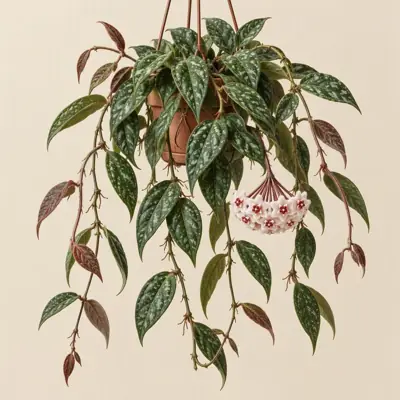
Few sources report that it can reach about 0–500 cm in mature height. Its growth rate is reported to be moderate. Leaves are reported to be sparsely distributed along the vine, usually opposite, with some nodes bearing a single leaf or none; they are thick, fleshy but firm, ovate to elongate-ovate or lanceolate, with a long-tapering tip and heart-shaped base, dark green with white markings, often turning red in direct sun, and hairy when young before gradually losing the hairs as they mature. Sources differ in describing the flowers: the umbels are pendent and flat to slightly concave, with radially symmetrical flowers whose white to pale pink corollas are densely softly hairy inside and have tail-like tapering lobes with inward-curled tips; the corona has dark red or pale red and white or dark red structures, while the flowers range from very faintly scented or scentless to weakly sweet-scented and produce no nectar. The fruit is reported to be a smooth follicle, round in cross-section, slightly narrowed and faintly striped toward the tip, with flat seeds bearing tufts of white hairs.
Light
Bright light, dappled shade to direct morning sun is generally recommended, while full-day direct sun is not recommended.
Watering
It is generally grown in a well-drained medium that is allowed to dry between waterings, avoiding prolonged wetness or standing water around the roots.
Temperature and dormancy
It is reported to be frost tender; keep above freezing.
Growing medium and mounting
A well-drained potting medium rich in organic matter is generally used.
Propagation
It is reported to be propagated by stem cuttings.
Common problems
Reported pests include aphids, spider mites, and mealybugs. Root rot is reported as a disease problem, and excessive water retention in the container or growing medium can keep roots wet for prolonged periods and increase its risk. It is reported to be sensitive to frost.
Identification
Hoya caudata is reported to be distinguished by slender twining vines, thick, firm, dark green leaves with white markings, and densely softly hairy white to pale pink corollas; young stems are dark red and bristly, older stems become green and nearly hairless, and the plant has white or yellow sap.
Photos

