
Hoya finlaysonii (Hoya finlaysonii)
Hoya finlaysonii is a climbing, twining vine with relatively stout pale-brown stems, and Hoya can be grown climbing or trailing. It is reported to be an evergreen herbaceous perennial.
Watch: 21 Hoyas: Water Less, Wait Longer
Overview
Hoya finlaysonii is a climbing, twining vine with relatively stout pale-brown stems, and Hoya can be grown climbing or trailing. It is reported to be an evergreen herbaceous perennial.
Origin and habitat
Sources differ on its native range in Southeast Asia: one account describes a range from Myanmar, southern Thailand, and the Malay Peninsula to Borneo and Sumatra in Indonesia, while another broadly describes it as extending from southern Thailand to western Malaysia; GBIF specimen records also occur in Malaysia, Thailand, Indonesia, Brunei, the Philippines, and Singapore, but the record set includes cultivated or escaped occurrences and cannot by itself establish native distribution. It is reported from tropical rainforest habitat.
Characteristics
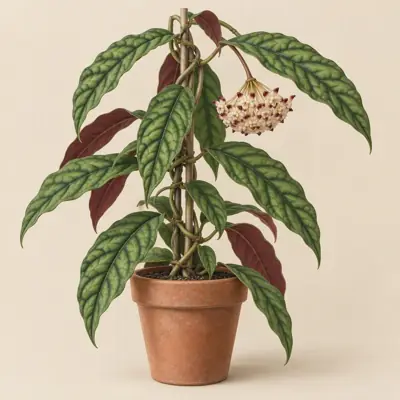
Sources differ in their characterization of its growth, with relatively slow growth described. The leaves are reported to be mostly opposite, with thick petioles and elliptical blades that are generally thick and leathery to stiff; the pale-green upper surface has raised, very conspicuous dark-green veins, while the underside is dark red, and the blade has a wedge-shaped base, pointed tip, and wavy margin, with texture varying among individuals from thin and soft to fleshy and very rigid. The inflorescences are reported to be rounded to convex above and may hang downward or extend horizontally; the flowers have a white to pale-yellow corolla with ovate, pointed, strongly reflexed lobes, dark-red lobe tips, fine hairs inside, and a glass-like white corona, while individual flowers are short-lived. It is reported to be capable of flowering throughout the year, and its fruits are described as slender, spindle-shaped follicles with cylindrical seeds.
Light
It is reported to suit bright light, dappled shade, or morning sun and does not require full sun throughout the day.
Watering
It is reported to suit a well-drained medium that is allowed to dry after watering before being watered again, while prolonged wetness and standing water should be avoided.
Temperature and dormancy
It is reported to be frost tender; keep above freezing.
Growing medium and mounting
It is reported to suit a fast-draining organic potting medium and not to tolerate prolonged wet, sticky conditions or water around the roots.
Propagation
Most Hoya are reported to be propagated by stem cuttings.
Common problems
Commonly reported Hoya pests include aphids, spider mites, and mealybugs. Excessive water retention in the container or medium is reported to cause root problems, including root rot, and prolonged wetness around the roots should be avoided. It is reported not to tolerate frost.
Identification
Its most conspicuous reported feature is the raised, strongly contrasting dark-green leaf venation, which the literature describes as distinctive; the leaf underside may be dark red and the margin wavy.