
Hoya latifolia (Hoya latifolia)
Hoya latifolia is an evergreen perennial climbing shrub or trailing plant that often grows as an epiphyte, with long, woody, sap-bearing stems, and it can also be grown trailing.
Watch: 21 Hoyas: Water Less, Wait Longer
Overview
Hoya latifolia is an evergreen perennial climbing shrub or trailing plant that often grows as an epiphyte, with long, woody, sap-bearing stems, and it can also be grown trailing.
Origin and habitat
Sources differ in their accounts of its native range in Southeast Asia, including Myanmar, southern Thailand, Malaysia, and Indonesia, with more detailed accounts naming Borneo, Java, and Sumatra. It is reported to occur in lowland forest, often growing as an epiphyte, mainly in humid tropical environments at low elevations.
Characteristics
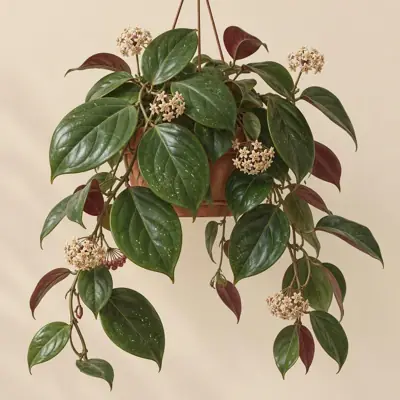
The leaves are reported to be large, fleshy, nearly round to elliptic, with a long-tapering tip and a rounded to heart-shaped base; the glossy green upper surface may have scattered white spots, while the underside is dark red, and the petiole is stout. Sources describe the flower count per inflorescence differently; the upright inflorescences bear globular clusters of flowers with white to brownish-yellow, finely hairy corollas whose ovate, pointed lobes bend backward when fully open, while the corona is white, creamy white, or slightly pinkish. The flowers are strongly fragrant, with a particularly strong musky scent at night, and remain open for a limited period. The follicles are reported to be spindle-shaped and slightly hairy.
Light
Provide bright conditions while avoiding strong direct sun during the hottest part of the day; Hoya species generally suit bright light, dappled shade, or morning sun.
Watering
Use a well-drained medium; potted Hoya can be allowed to dry between waterings, while prolonged wetness and waterlogged roots should be avoided.
Humidity and airflow
It is reported to prefer high humidity.
Temperature and dormancy
It is reported to be frost tender; keep above freezing.
Growing medium and mounting
Use a humus-rich, fertile, well-drained medium that retains some moisture; potted Hoya suit a fast-draining medium rich in organic matter.
Propagation
It can be propagated from seed, semi-ripe cuttings, or layering, and most Hoya species also propagate readily from stem cuttings.
Common problems
Cultivated Hoya are reported to be susceptible to aphids, spider mites, and mealybugs. Prolonged wetness, waterlogged roots, or poor drainage is reported to cause or lead to root rot. Hoya are reported not to tolerate frost.
Identification
Hoya latifolia is reported to have very large, fleshy leaves with prominent veins that are important for identification, along with dark red young shoots.
Photos

