
Hoya pubicalyx (Hoya pubicalyx)
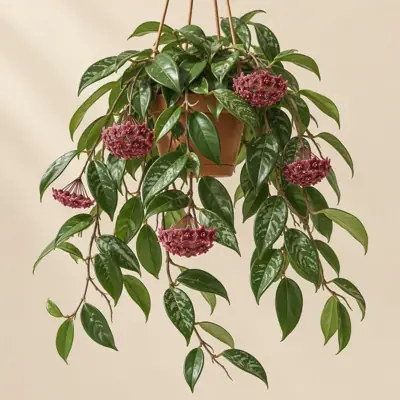
Hoya pubicalyx is a perennial, evergreen epiphytic vine with a twining, climbing or trailing habit; it can grow along a support or trail from a hanging container.
Watch: 21 Hoyas: Water Less, Wait Longer
Overview
Hoya pubicalyx is a perennial, evergreen epiphytic vine with a twining, climbing or trailing habit; it can grow along a support or trail from a hanging container.
Origin and habitat
Hoya pubicalyx is native to the Philippines and is an epiphyte of tropical rainforest. The type specimen was collected from a tree in a very humid riverside environment on Luzon in the Philippines. It occurs in tropical, warm and humid conditions and does not tolerate frost.
Characteristics
Sources differ on mature height, placing it at about 250–400 cm, while a single source reports a mature spread of about 100–150 cm. Growth is relatively slow at typical indoor-plant scale, and all-green forms usually grow faster than variegated forms; the opposite leaves are thick and fleshy to leathery and glossy, with shapes ranging from narrow and elongated to elliptic or elliptic-ovate, tapered tips, slightly recurved margins, and often gray-white or silver spotting, while some plants have red or red-and-green young leaves that become green as they mature. The many waxy flowers form hemispherical to nearly spherical umbels, with star-shaped coronas and colors ranging from pale pink through rose and red to deep burgundy or nearly black; colors can vary within an umbel, the outer sepals are hairy, the inside of the corolla is densely covered with tiny white papillae, and the fragrance is especially noticeable at night. No specific flowering months are given; a specialist source reports that flowering in cultivation can continue for an extended period.
Light
Sources differ somewhat on light: bright filtered or bright indirect light is favored in indoor-growing information, with brief morning direct light acceptable, while prolonged strong direct light can scorch the leaves; some sources also list full sun.
Watering
Water regularly during the growing season while allowing the medium to dry between waterings, and do not leave it persistently waterlogged; reduce watering in autumn and winter while maintaining good airflow and drainage.
Humidity and airflow
Hoya pubicalyx prefers high humidity and needs good airflow; sources differ on a humidity range of about 60–70 %.
Temperature and dormancy
The minimum temperature is 10 °C, and the plant is frost tender; keep above freezing. It has USDA and RHS hardiness classifications.
Growing medium and mounting
Use a fast-draining, loose and well-aerated epiphytic growing medium; formulations may contain loam-based medium, coarse sand, bark, charcoal or perlite, while coconut husk or orchid medium can also be used. The medium should not remain saturated for long periods, and the plant can adapt to acidic, neutral or alkaline conditions.
Feeding
Apply fertilizer suitable for epiphytes regularly during the growing season; a specialist source recommends a fertilizer higher in potassium and phosphorus and lower in nitrogen.
Propagation
It is reported to be propagated by semi-hardwood cuttings or layering.
Common problems
Potential pests include mealybugs, aphids, greenhouse whiteflies and scale insects. Disease problems are generally uncommon, but persistently wet potting medium can lead to root rot. Overwatering can cause root rot and leaf drop, strong direct light can scorch leaves, and low temperatures can damage foliage. It is sensitive to frost and low temperatures and should be protected from freezing and cold conditions.
Identification
Key identifying features include a twining vine habit, thick leathery to fleshy leaves often marked with silver-gray spots, densely clustered rounded umbels of star-shaped flowers with fragrance at night, and finely hairy sepals.
Photos


Sources
- Wikipedia (en): Hoya pubicalyx — CC BY-SA 4.0 · link
- Wikipedia (de): Hoya pubicalyx — CC BY-SA 4.0 · link
- NC State Plant Toolbox: Hoya pubicalyx — copyright (facts only) · link
- LLIFLE Encyclopedia of living forms: Hoya pubicalyx — CC BY-SA · link
- RHS Plants: Hoya pubicalyx — © RHS, facts only · link
- Top Tropicals catalog: Hoya pubicalyx — © Top Tropicals LLC (facts only) · link