
Hoya wayetii (Hoya wayetii)
Hoya wayetii is a perennial evergreen vine that can climb, twine, or trail, with branching stems that may hang downward.
Watch: 21 Hoyas: Water Less, Wait Longer
Overview
Hoya wayetii is a perennial evergreen vine that can climb, twine, or trail, with branching stems that may hang downward.
Origin and habitat
Hoya wayetii is native to the Philippines, with more specific records from Benguet Province on Luzon. It is reported to be an epiphyte of tropical montane forest in a tropical montane environment.
Characteristics
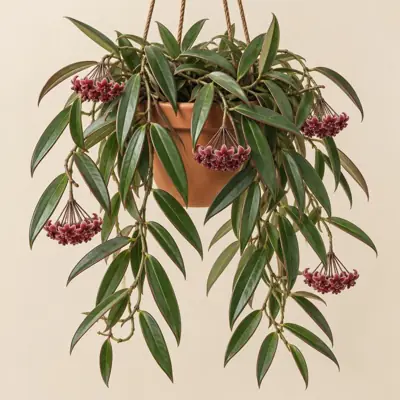
Few-source information reports a mature height of about 50–100 cm and a spread of about 10–50 cm. Sources describe the leaves differently; they are opposite, fleshy, and narrowly lanceolate, with a wedge-shaped base, pointed tip, prominent midrib, dark green surface, and darker margins that often become red in ample sunlight. Sources describe the flowers differently; they occur in pendent umbels and have strongly reflexed dark red corolla lobes, a dark red corona with an exception at its tips, and a strong honey fragrance. The cited description reports that fruit and seeds have not been observed.
Light
Sources describe this differently: bright, filtered light is given for indoor cultivation, while RHS position information also lists full sun.
Watering
Use a well-drained medium; water thoroughly during the growing season, keep it only slightly moist in winter, and avoid waterlogging or prolonged wetness.
Humidity and airflow
Hoya wayetii is reported to prefer high humidity.
Temperature and dormancy
A limited source reports a temperature minimum of about 15 °C. It is generally listed as RHS H1A and as frost tender; keep above freezing.
Growing medium and mounting
A well-drained potting medium is recommended; one reported option is a peat-free, loam-based medium with coarse sand, bark, and charcoal, while loamy or sandy soils and acidic, neutral, or alkaline conditions are listed as acceptable.
Propagation
It is reported to be propagated by layering in spring or summer, or from semi-ripe cuttings in late summer with bottom heat to promote rooting.
Common problems
Possible pests include mealybugs, glasshouse whitefly, and scale insects, while genus-level Hoya information additionally records aphids and spider mites. It is generally reported to have few diseases. It does not tolerate a waterlogged medium, and prolonged excessive moisture may cause root problems; genus-level Hoya information specifically records root rot from excessive moisture. It is reported to suit a sheltered position and is listed as RHS H1A for hardiness.
Identification
It is reported to have slender fleshy leaves that are dark green with darker margins, which often turn red in ample sunlight, along with strongly reflexed dark red corolla lobes; its appearance can be confused with Hoya kentiana and Hoya shepherdii.
Photos


Sources
- GBIF Backbone: Hoya wayetii Kloppenb. — CC BY 4.0 · link
- Wikipedia (en): Hoya wayetii — CC BY-SA 4.0 · link
- Wikipedia (de): Hoya wayetii — CC BY-SA 4.0 · link
- Wikipedia (nl): Hoya wayetii — CC BY-SA 4.0 · link
- RHS Plants: Hoya wayetii — © RHS, facts only · link
- NC State Plant Toolbox: Hoya (genus-level) — copyright (facts only) · link