
garden hyacinth (Hyacinthus orientalis)
Hyacinthus orientalis is a bulbous perennial herb with an underground bulb, basal leaves, and an upright flowering stem bearing a raceme.
Overview
Hyacinthus orientalis is a bulbous perennial herb with an underground bulb, basal leaves, and an upright flowering stem bearing a raceme.
Origin and habitat
Sources differ on its native range, describing western Asia with a core range around southern Turkey, Syria to Lebanon, and northern Israel. Natural habitats include rocky ground, limestone slopes, scrub, gravelly ground, and cliffs, with records extending into high-elevation habitats. It favors cool conditions with winter cold, its dormant bulbs have some cold hardiness, and it is widely cultivated in temperate regions.
Characteristics
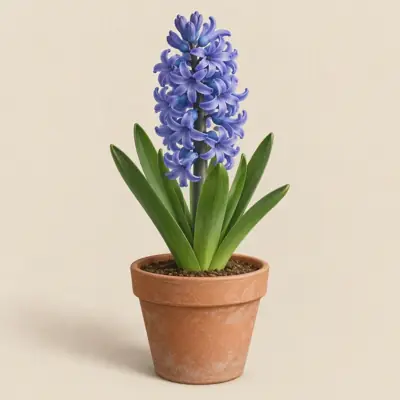
Sources differ on mature height, placing it at about 15–50 cm. A single source reports a mature spread of about 0–10 cm, so sources are few. The basal leaves are strap-shaped to linear, fleshy or glossy, and often grooved; wild forms may have narrower leaves. Sources differ in their flower descriptions: fragrant flowers form racemes, native forms are generally purple to blue-purple, while horticultural forms occur in blue, purple, white, yellow, pink, red, and orange; individual flowers are tubular to bell-shaped with a divided perianth, and cultivated forms usually have denser inflorescences than wild forms. Flowering is mainly from early to mid-spring, while horticultural sources also report winter flowering through cultivation or forcing; a single source reports fleshy, nearly spherical capsules that dry and split when mature, containing black seeds with elaiosomes that ants can carry and disperse.
Light
It grows in full sun to partial sun; flowering is better with ample sunlight, while severe lack of light may prevent flowering.
Watering
Keep it moderately moist in well-drained conditions without waterlogging, maintaining moisture initially after planting to promote rooting and gradually reducing watering after flowering as the bulb enters dormancy. When grown in water, keep the water clean and avoid prolonged excessive submersion of the bulb.
Temperature and dormancy
Its reported hardiness includes USDA and RHS classifications, and a single source places the lower temperature at about -5 °C, so sources are few. It is generally reported to tolerate brief light frost.
Growing medium and mounting
Use well-drained, moderately fertile soil; sandy soil or sandy loam can be used, and it can also adapt to chalky soil, clay, and loam. The soil should not remain waterlogged for prolonged periods.
Feeding
Sources describe feeding differently: fertilizer can be applied around the end of flowering to support bulb enlargement, while for single-use potted plants grown from imported bulbs in Taiwan, the agricultural knowledge portal states that commercial potted plants that have already rooted and produced leaves usually do not need fertilizer.
Propagation
Sources differ in their propagation descriptions: Hyacinthus orientalis can be propagated by seed and bulb division; horticultural methods include separating offsets during dormancy and cutting or wounding the base of the bulb to encourage offsets.
Common problems
A single source reports that bulb mites and narcissus bulb flies may cause damage. Excessive moisture can lead to bulb rot, severe lack of light may prevent flowering, and one-sided window light can cause flower stalks to lean toward the light. It favors cool conditions and requires a period of low temperature; container plants should be protected from severe frost and excessive moisture. Taiwan's subtropical, high-temperature conditions are unfavorable for rebuilding or maintaining bulbs after flowering.
Identification
Hyacinthus orientalis has a conspicuous underground bulb, basal strap-shaped fleshy leaves, and a flowering stem topped by a fragrant raceme; wild forms have looser inflorescences, while modern horticultural forms usually have dense inflorescences and varied flower colors.
Photos


Sources
- Wikipedia (en): Hyacinthus orientalis — CC BY-SA 4.0 · link
- 維基百科:風信子 — CC BY-SA 4.0 · link
- Wikipedia (ja): ヒヤシンス — CC BY-SA 4.0 · link
- Wikipedia (de): Gartenhyazinthe — CC BY-SA 4.0 · link
- Wikipedia (fr): Hyacinthus orientalis — CC BY-SA 4.0 · link
- GBIF descriptions: Manual of the Alien Plants of Belgium; DAISIE - Inventory of alien invasive species in Europe; Globa — per dataset · link
- NC State Plant Toolbox: Hyacinthus orientalis — copyright (facts only) · link
- Wikipedia (nl): Hyacint (soort) — CC BY-SA 4.0 · link
- 農業知識入口網 植物圖鑑: Hyacinthus orientalis — © MOA, facts only · link
- Useful Tropical/Temperate Plants: Hyacinthus orientalis — CC BY-NC-SA 3.0 (facts only) · link
- RHS Plants: Hyacinthus orientalis — © RHS, facts only · link
- USDA PLANTS Database: Hyacinthus orientalis — Public domain (US Government work) · link
- Top Tropicals catalog: Hyacinthus orientalis — © Top Tropicals LLC (facts only) · link