
Bigleaf Hydrangea (Hydrangea macrophylla)
Hydrangea macrophylla is a perennial, deciduous plant and a woody, multi-stemmed shrub, although sources differ and some describe the wild form as a subshrub.
Overview
Hydrangea macrophylla is a perennial, deciduous plant and a woody, multi-stemmed shrub, although sources differ and some describe the wild form as a subshrub.
Origin and habitat
Hydrangea macrophylla is native to Japan, although sources differ, with some accounts also specifying the Volcano Islands. Its habitats include sunny coastal areas and coastal woodlands in Japan, and it is also widely grown in gardens, parks, and other cultivated horticultural settings. It is reported to be cultivable in a variety of climates and is widely grown as an ornamental plant in temperate regions.
Characteristics
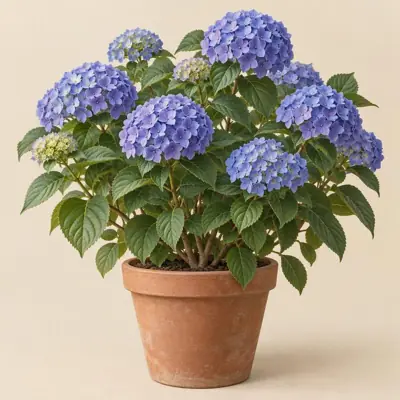
Sources differ on mature size, reporting a height of about 100–300 cm and a spread of about 91–250 cm. It grows quickly and has opposite, simple leaves that are usually ovate to elliptic, with pointed tips and serrated margins. The large inflorescences of wild forms are usually relatively flat corymbose or cymose clusters, generally with small fertile flowers in the center and large, conspicuous sterile decorative flowers around them; cultivated forms commonly include flat lacecap and nearly spherical mophead inflorescences, with flowers in white, pink, red, blue, or purple, and the color of some cultivars can shift from pink toward blue depending on soil acidity and aluminum availability. Sources differ on flowering duration: flowering is mainly from late spring through summer, with some accounts extending it into autumn or even early winter; the fruit is reported to be a nearly spherical capsule.
Light
It is suited to partial sun through shade and can also grow in full sun; in hot or low-rainfall conditions, direct sunlight during the hottest part of the day is best avoided.
Watering
It needs regular watering and prefers soil that keeps the root zone moist while draining well; it does not tolerate dry roots, although briefly wetter conditions are acceptable.
Humidity and airflow
It is generally reported to prefer high humidity and to need little air movement.
Temperature and dormancy
Sources differ on cold limits, with the limited available information placing the minimum at about -10 °C. It is generally described as frost hardy. A single source also reports a USDA hardiness-zone range, without a confirmed numerical range here.
Growing medium and mounting
It adapts to various soils, including clay, sandy soil, and ordinary soil, while preferring well-drained loam and a root zone that does not become overly dry. It can grow from strongly acidic to alkaline soils, though shallow calcareous soil may cause chlorosis, and soil acidity and aluminum availability can affect flower color in some cultivars.
Feeding
Fertilizers or organic materials can alter soil acidity and aluminum availability and thereby adjust flower color in some cultivars.
Propagation
It can be propagated by stem cuttings and layering. Taiwanese agricultural information recommends taking previous-season stems before early-spring budding for cuttings, while Japanese information also describes propagation by cuttings during the rainy season.
Common problems
It is reported to be particularly susceptible to disease caused by honey fungus, and white-tailed deer are reported to cause feeding problems. An overly dry root zone can impair growth, shallow calcareous soil can cause chlorosis, and missing the appropriate pruning period can affect the next flowering cycle. Tender spring shoots are sensitive to frost, while shade during the hottest part of the day is advisable in hot or low-rainfall areas. Mature plants can withstand some cold, but sources differ substantially in their descriptions of cold tolerance.
Identification
Large opposite serrated leaves and large inflorescences are conspicuous identifying features; horticultural forms commonly have spherical mophead inflorescences or lacecap inflorescences edged with large decorative flowers, and many cultivars have flower colors influenced by soil acidity and aluminum availability.
Photos


Sources
- GBIF Backbone: Hydrangea macrophylla (Thunb.) Ser. — CC BY 4.0 · link
- Wikipedia (en): Hydrangea macrophylla — CC BY-SA 4.0 · link
- 維基百科:绣球花 — CC BY-SA 4.0 · link
- Wikipedia (ja): アジサイ — CC BY-SA 4.0 · link
- Wikipedia (de): Gartenhortensie — CC BY-SA 4.0 · link
- Wikipedia (fr): Hydrangea macrophylla — CC BY-SA 4.0 · link
- Wikipedia (es): Hydrangea macrophylla — CC BY-SA 4.0 · link
- GBIF descriptions: Manual of the Alien Plants of Belgium; Lista de especies de plantas exóticas y trasplantadas de Colo — per dataset · link
- NC State Plant Toolbox: Hydrangea macrophylla — copyright (facts only) · link
- Wikipedia (it): Hydrangea macrophylla — CC BY-SA 4.0 · link
- Wikipedia (nl): Grote hortensia — CC BY-SA 4.0 · link
- Wikipedia (pt): Hydrangea macrophylla — CC BY-SA 4.0 · link
- 農業知識入口網 植物圖鑑: Hydrangea macrophylla — © MOA, facts only · link
- Useful Tropical/Temperate Plants: Hydrangea macrophylla — CC BY-NC-SA 3.0 (facts only) · link