
panicled hydrangea (Hydrangea paniculata)
Hydrangea paniculata is a perennial deciduous woody plant that grows as a shrub to a small tree.
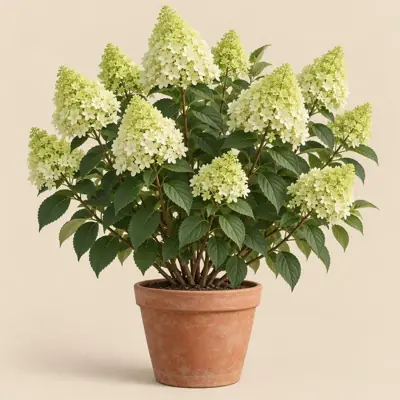
Overview
Hydrangea paniculata is a perennial deciduous woody plant that grows as a shrub to a small tree.
Origin and habitat
Sources differ in describing its native range: it is native from East Asia into Northeast Asia, including China, Japan, Korea, Sakhalin in Russia, and the southern Kuril Islands, while a Taiwan database lists populations in Taiwan as native. Its habitats include moist mountain open woodland, scrub, forest edges, valleys, and areas near streams. It is a temperate East Asian plant that can grow in regions with cold winters and favors environments with ample moisture.
Characteristics
Sources differ on mature height, placing it at about 100–500 cm, while mature spread is 150–250 cm. It grows rapidly and has green, simple, ovate to elliptic leaves with serrated margins, usually opposite but sometimes arranged in whorls. Large terminal panicles contain smaller white to creamy-white fertile flowers and more conspicuous white to pinkish-white sterile ornamental flowers; flower color can change as the flowers age, and flowering occurs from summer into early autumn. It is reported to produce woody, many-seeded capsules with small brown, spindle-shaped seeds bearing short wings at both ends, and the fruits can remain at the ends of branches into winter.
Light
It grows in full sun to partial sun; in sunny conditions the soil should remain reliably moist, while direct light during the hottest part of the day can be avoided in hot or low-rainfall conditions.
Watering
Keep moisture available around the roots while maintaining good drainage; it suits moist, well-drained soil and does not favor dry roots, and it can accept full sun when the soil remains consistently moist.
Temperature and dormancy
A single source reports a minimum temperature of about -25 °C, so evidence for this figure is limited.
Growing medium and mounting
Sources differ in their descriptions, but moist, well-drained clay, loam, or sandy soil is suitable, and excessively dry soil is unfavorable for growth. The reported soil pH tolerance is broad, with RHS listing acidic, neutral, and alkaline soils as suitable.
Propagation
It can be propagated from seed or stem cuttings; RHS indicates sowing in spring and taking softwood cuttings in early summer.
Common problems
It is reported to be susceptible to aphids and mites and particularly susceptible to honey fungus. It is reported to be subject to browsing by white-tailed deer and wind damage; its root system is shallow, and covering the root zone can aid cultivation. Dormant plants are strongly cold-hardy, but new spring shoots can be damaged by late frost, while strong sunlight in dry conditions increases water demand.
Identification
Hydrangea paniculata is distinguished by large terminal panicles containing both smaller fertile flowers and large, conspicuous ornamental flowers, and it is among the hydrangea types that can flower on new growth from the current year.
Photos


Sources
- Wikipedia (en): Hydrangea paniculata — CC BY-SA 4.0 · link
- 維基百科:圆锥绣球 — CC BY-SA 4.0 · link
- Wikipedia (ja): ノリウツギ — CC BY-SA 4.0 · link
- Wikipedia (de): Rispen-Hortensie — CC BY-SA 4.0 · link
- Wikipedia (fr): Hydrangea paniculata — CC BY-SA 4.0 · link
- GBIF descriptions: Manual of the Alien Plants of Belgium; Database of Vascular Plants of Canada (VASCAN); Global Regist — per dataset · link
- NC State Plant Toolbox: Hydrangea paniculata — copyright (facts only) · link
- TaiCOL 臺灣物種名錄: Hydrangea paniculata — CC BY 4.0 · link
- Useful Tropical/Temperate Plants: Hydrangea paniculata — CC BY-NC-SA 3.0 (facts only) · link
- RHS Plants: Hydrangea paniculata — © RHS, facts only · link
- USDA PLANTS Database: Hydrangea paniculata — Public domain (US Government work) · link