
polkadot-plant (Hypoestes phyllostachya)
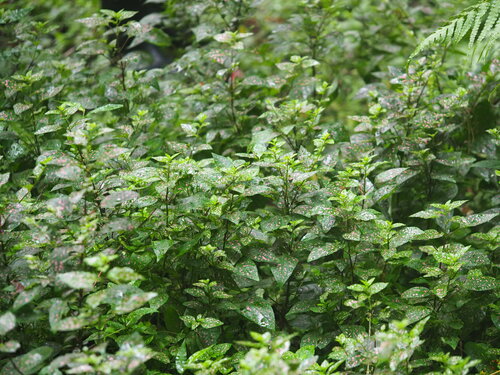
Sources describe Hypoestes phyllostachya differently, but it is described as an evergreen, densely clumping herbaceous perennial to subshrub with a sometimes slightly creeping habit. It is a perennial and is often grown as an annual in colder regions.
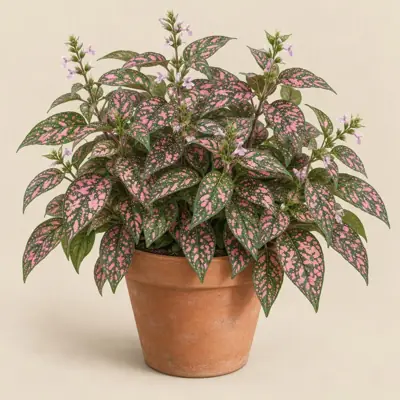
Overview
Sources describe Hypoestes phyllostachya differently, but it is described as an evergreen, densely clumping herbaceous perennial to subshrub with a sometimes slightly creeping habit. It is a perennial and is often grown as an annual in colder regions.
Origin and habitat
Sources differ on its native range: Madagascar is listed, while some sources also include South Africa and Southeast Asia. It is suited to warm subtropical to tropical environments; in colder regions it is generally grown as an annual or moved indoors for winter.
Characteristics
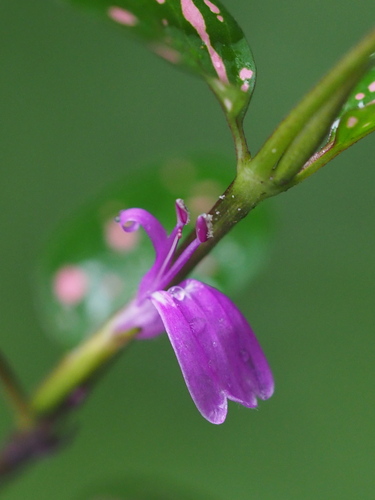
Sources differ on mature height, with the few sources indicating about 20–100 cm; a single source reports a mature spread of about 10–50 cm. The opposite leaves are ovate with pointed tips, usually dark green and densely marked with pink, rose-pink, white, or red spots or patches; some cultivars also have stripes, and the markings are usually paler on the undersides. Sources describe the flowers differently; they are small, tubular, and two-lipped, may be pink, magenta, pale purple, or white, and may occur at the nodes or in terminal flower spikes. A single source reports a dehiscent, many-seeded capsule.
Light
Provide bright indirect light to partial sun; some direct sunlight is tolerated, but strong direct light may cause the leaves to shrivel or curl, while insufficient light may fade leaf color and cause elongated growth.
Watering
Water regularly during the growing period in a well-drained growing medium, reduce watering in winter, and avoid prolonged dryness because drought tolerance is low.
Humidity and airflow
Hypoestes phyllostachya prefers high humidity.
Temperature and dormancy
A single source reports a minimum temperature of about 10 °C, so sources are few. Sources differ on the reported hardiness zone. It is generally frost tender; keep above freezing.
Growing medium and mounting
Use a well-drained growing medium; a loam-based potting medium is specified, with an acidic to neutral soil reaction.
Feeding
A balanced liquid fertilizer can be applied regularly during the warm growing period, including during summer.
Propagation
Propagation can be by seed or cuttings, including stem, softwood, or semi-ripe cuttings.
Common problems
Sources differ on pests: aphids, whiteflies, and mealybugs may occur, while another source describes pest problems as generally uncommon. A single source reports that powdery mildew may occur. Strong direct sunlight is reported to cause leaf shriveling or curling, while insufficient light may fade the markings and cause elongated growth. It is sensitive to frost and low temperatures; in cold regions it is grown as an annual or moved indoors for winter.
Identification
Its most conspicuous feature is its green, ovate foliage densely marked with white, pink to red spots or patches, with varied leaf colors and markings among cultivars.
Photos


Sources
- Wikipedia (en): Hypoestes phyllostachya — CC BY-SA 4.0 · link
- Wikipedia (fr): Hypoestes phyllostachya — CC BY-SA 4.0 · link
- Wikipedia (es): Hypoestes phyllostachya — CC BY-SA 4.0 · link
- GBIF descriptions: Lista de especies de plantas exóticas y trasplantadas de Colombia; Catálogo de Plantas y Líquenes de — per dataset · link
- NC State Plant Toolbox: Hypoestes phyllostachya — copyright (facts only) · link
- Wikipedia (pt): Hypoestes phyllostachya — CC BY-SA 4.0 · link
- RHS Plants: Hypoestes phyllostachya — © RHS, facts only · link
- USDA PLANTS Database: Hypoestes phyllostachya — Public domain (US Government work) · link
- Top Tropicals catalog: Hypoestes phyllostachya — © Top Tropicals LLC (facts only) · link