
New Guinea Impatiens (Impatiens hawkeri)
Impatiens hawkeri is an herbaceous plant whose habit ranges from creeping to upright, and cultivated plants often form clumps or mounds. Sources describe its life cycle differently: it is a herbaceous perennial but is also commonly grown as a seasonal annual in horticultural production and in colder regions.
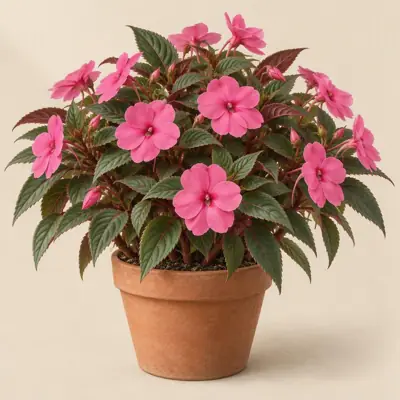
Overview
Impatiens hawkeri is an herbaceous plant whose habit ranges from creeping to upright, and cultivated plants often form clumps or mounds. Sources describe its life cycle differently: it is a herbaceous perennial but is also commonly grown as a seasonal annual in horticultural production and in colder regions.
Origin and habitat
Impatiens hawkeri is native from New Guinea to the Solomon Islands, including Papua New Guinea. It is reported from moist, shaded or partly shaded sites in montane to lower-montane forests, especially near streams and riverbanks. Its native environments include the subtropical highlands and moist montane forests of New Guinea, and it is also widely grown as an ornamental plant from tropical to temperate regions.
Characteristics
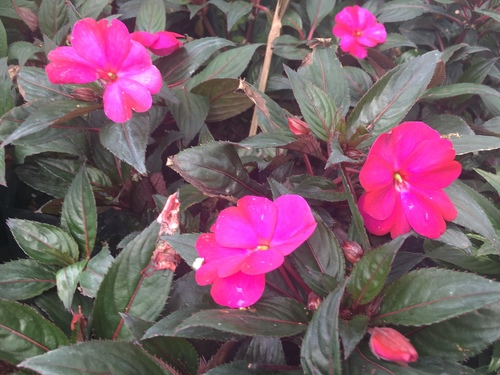
Sources differ on mature height, giving a range of about 15.24–50.8 cm. The leaves are lance-shaped and are larger and longer than those of African impatiens; the marginal teeth may bear stalked glands, and the undersides are often red or purple. Flowers may be solitary or borne in small groups and have a conspicuous slender, elongated spur; cultivated forms vary widely in flower size, color, and form, including white, pink, red, purple, yellow, orange, deep pink, bicolored, and double-flowered forms. Sources differ on flowering season because it varies with climate: records from Taiwan describe winter and spring flowering, North Carolina horticultural information describes flowering from spring through autumn, and suitable tropical environments may support flowering and fruiting year-round; mature capsules can suddenly release and disperse their seeds.
Light
It can adapt from full sun to shade but performs better in partial sun or partial shade; it needs protection from intense hot sun, and water demand rises with greater sun exposure.
Watering
Keep the growing medium moist but well drained and avoid waterlogging; water demand increases with greater sun exposure, while Taiwan agricultural information recommends drip irrigation and notes that excessive medium moisture can impair growth.
Temperature and dormancy
Few sources report a minimum temperature, with one giving about 10 °C. Few sources report an ideal temperature range, with one giving about 15–25 °C. It is generally described as frost tender; keep above freezing. A single source reports a limited USDA hardiness range for it.
Growing medium and mounting
Use a moist, well-drained growing medium rich in organic matter or humus; Taiwan cultivation information recommends clean, well-drained soil and specifies a suitable mildly acidic pH range.
Feeding
It is reported to be sensitive to fertilizer injury, so fertilizer should be applied lightly.
Propagation
It can be propagated by seed or cuttings; sources differ in their recommended germination conditions, and cuttings with weaker root systems require attention to the risk of rot.
Common problems
Several bacterial, fungal, and oomycete diseases may occur, while some cultivars have good resistance to downy mildew, Phytophthora-related disease, and leaf spot. Poor drainage or an excessively wet growing medium can favor soil-borne disease, cuttings with weak root systems may rot, and overly concentrated fertilizer may cause fertilizer injury. It is sensitive to frost and low temperatures and should be kept from freezing in winter; intense hot sun also calls for suitable protection and increased water supply.
Identification
It is reported to have flowers with a conspicuous elongated spur, nearly round and broad lateral sepals with tapering tips, stalked glands on the leaf teeth that project above the leaf surface, and leaf undersides that are often reddish purple.
Photos


Sources
- Wikipedia (en): Impatiens hawkeri — CC BY-SA 4.0 · link
- Wikipedia (ja): ニューギニアインパチェンス — CC BY-SA 4.0 · link
- Wikipedia (es): Impatiens hawkeri — CC BY-SA 4.0 · link
- NC State Plant Toolbox: Impatiens hawkeri — copyright (facts only) · link
- Wikipedia (nl): Nieuw-Guinea-impatiens — CC BY-SA 4.0 · link
- TaiCOL 臺灣物種名錄: Impatiens hawkeri — CC BY 4.0 · link
- 農業知識入口網 植物圖鑑: Impatiens hawkeri — © MOA, facts only · link
- Useful Tropical/Temperate Plants: Impatiens hawkeri — CC BY-NC-SA 3.0 (facts only) · link
- Top Tropicals catalog: Impatiens hawkeri — © Top Tropicals LLC (facts only) · link