
swamp morning-glory (Ipomoea aquatica)
Ipomoea aquatica is a trailing, creeping, or floating herb that can grow in water or wet soil, with stems that root at the nodes. Sources differ on whether it is annual or perennial, with perennial growth depending on the growing region and overwintering conditions.
Overview
Ipomoea aquatica is a trailing, creeping, or floating herb that can grow in water or wet soil, with stems that root at the nodes. Sources differ on whether it is annual or perennial, with perennial growth depending on the growing region and overwintering conditions.
Origin and habitat
It is native to Asia, with most sources pointing to Southeast Asia or tropical Asia, although accounts of its native range differ. Sources differ in their descriptions of its habitat, which includes moist, marshy, or flooded environments such as freshwater ditches, streams, ponds, rice fields, shallow water, other waterside wetlands, and wet soil. It prefers warm, humid tropical to subtropical conditions, tolerates high temperatures, and does not tolerate frost well.
Characteristics
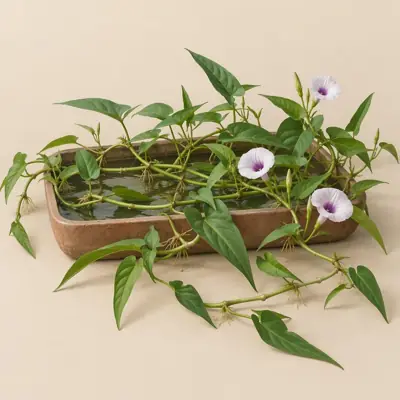
Sources are few and differ on mature height, reporting about 50–50 cm, while mature spread is 200–300 cm. It grows rapidly, with vigorous trailing stems that can form extensive vegetation. Sources differ in describing the alternate, simple leaves, which vary greatly in shape and may be lance-shaped, elongate-ovate, ovate, heart-shaped, or arrow-shaped; they are mostly hairless, with entire or wavy margins. It is reported to have funnel- or trumpet-shaped flowers, commonly white but also pink, pale purple, or purple, sometimes with a darker or pale-purple center; flowering can occur in summer and autumn, and flower-bud formation is influenced by short-day conditions; the fruit is reported to be a woody capsule that may resist opening or remain closed, with seeds in each chamber that can be light brown or black.
Light
It is reported to grow in full sun.
Watering
It requires abundant water and suits wet soil, shallow water, ponds, or other continuously moist environments; when grown on dry land, it should be kept from drying out.
Humidity and airflow
It is reported to prefer high humidity.
Temperature and dormancy
Sources differ on the lower temperature threshold, placing it at about 10 °C. The ideal temperature is 25–30 °C, and the maximum is 40 °C. It is generally frost tender; keep above freezing.
Growing medium and mounting
It tolerates a broad range of soils, including wet soils and heavy clay, while organic-rich soil supports leaf production; it also has a preferred soil reaction and a wider recorded tolerance.
Feeding
It is reported that nutrient deficiency should be avoided to maintain production of tender stems and leaves, and that supplemental feeding can begin once plants have reached an established height, with organic fertilizer or chicken manure given as examples.
Propagation
It is reported to propagate by seed or stem cuttings; stem nodes root readily, allowing cuttings to propagate quickly.
Common problems
Dryness or low temperatures can impair growth, and overly dense growth can produce thin, weak new shoots; plants grown in polluted waters have been reported to accumulate heavy metals. It is reported to be very intolerant of low temperatures and frost, with growth rapidly deteriorating in cold conditions and stems and leaves dying after frost, while it tolerates hot conditions.
Identification
It is reported to have hollow, buoyant stems that creep or float on the water surface and readily produce adventitious roots at the nodes, providing a conspicuous identification feature.
Photos


Sources
- Wikipedia (en): Ipomoea aquatica — CC BY-SA 4.0 · link
- 維基百科:蕹菜 — CC BY-SA 4.0 · link
- Wikipedia (ja): ヨウサイ — CC BY-SA 4.0 · link
- Wikipedia (de): Wasserspinat — CC BY-SA 4.0 · link
- Wikipedia (fr): Ipomoea aquatica — CC BY-SA 4.0 · link
- Wikipedia (es): Ipomoea aquatica — CC BY-SA 4.0 · link
- GBIF descriptions: An updated checklist of aquatic plants of Myanmar and Thailand; Lista de especies de plantas exótica — per dataset · link
- Useful Tropical/Temperate Plants: Ipomoea aquatica — CC BY-NC-SA 3.0 (facts only) · link
- USDA PLANTS Database: Ipomoea aquatica — Public domain (US Government work) · link