
Ipomoea platensis (Ipomoea platensis)
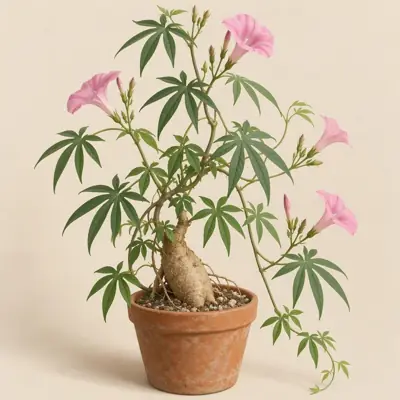
Ipomoea platensis is a perennial vine with a robust swollen root or tuber-like base; its stems may creep, grow upright, or twine, and in cultivation it often climbs or trails.
Overview
Ipomoea platensis is a perennial vine with a robust swollen root or tuber-like base; its stems may creep, grow upright, or twine, and in cultivation it often climbs or trails.
Origin and habitat
Sources differ in describing its native range in southeastern South America, with records from Argentina, Paraguay, Uruguay, and Paraná in Brazil. It is reported mainly from marshy wetlands along the Paraná–Pilcomayo river system, and also from dry Andean intermontane valleys in Salta, Argentina. It occurs in southeastern South American wetlands as well as dry intermontane valleys at higher elevations, and horticultural sources place it in warm USDA zones.
Characteristics
A single source reports a mature height of about 360–360 cm; sources are few. Sources differ in describing the petiolate leaves, which are deeply palmately divided nearly to the base, with oblong-oblanceolate lobes, blunt or pointed tips, margins from entire to wavy, hairless surfaces, and a paler underside. Sources differ in describing the flowers as pink to pale purple and funnel- or trumpet-shaped, borne in axillary cymes. The plant has a swollen root, and its vines can become long while the swollen base can become broad; the fruit is reported to be a nearly spherical, hairless, beaked capsule with hairy seeds bearing longer hairs along the edges.
Light
It grows in bright partial sun, partial shade, or filtered sunlight.
Watering
It is generally reported to need regular to moderate watering, allowing the surface to become slightly dry before watering again and avoiding prolonged wetness around the swollen root to reduce the risk of rot. While in leaf, keep slightly dry.
Temperature and dormancy
Sources differ on the minimum temperature, with limited information placing it at about -2–-2 °C. Sources differ on its USDA hardiness-zone classification, while specialist-supported information indicates that it tolerates brief light frost. A single source places the cold minimum at about -2–-2 °C; sources are few.
Growing medium and mounting
It is reported to need a well-drained, fast-draining mix, with the surface allowed to become slightly dry between waterings and the swollen root kept from remaining continuously wet.
Propagation
It is reported to be propagated by seed or cuttings.
Common problems
The swollen root is reported to be at risk of rot if it remains overly wet for prolonged periods. Young plants need protection from cold, while mature plants tolerate only brief light frost or low temperatures; in cold regions, protection or moving plants indoors during the cold season is recommended.
Identification
Ipomoea platensis is distinguished by a conspicuously robust swollen root or enlarged woody base, long climbing or creeping stems, deeply palmately divided leaves, and large pink funnel-shaped flowers.
Photos


Sources
- GBIF Backbone: Ipomoea platensis Ker Gawl. — CC BY 4.0 · link
- Wikipedia (en): Ipomoea platensis — CC BY-SA 4.0 · link
- GBIF descriptions: A foundation monograph of Ipomoea (Convolvulaceae) in the New World — per dataset · link
- Desert-Tropicals: Ipomoea platensis — © Philippe Faucon (desert-tropicals.com), facts only · link
- Top Tropicals catalog: Ipomoea platensis — © Top Tropicals LLC (facts only) · link
- PUKUBOOK: Ipomoea platensis — CC BY-NC (facts only) · link
- Ipomoea platense | Giromagi cactus and succulents | Buy plants online (www.giromagi.com) — facts only (§12) · link