
scarlet jungleflame (Ixora coccinea)
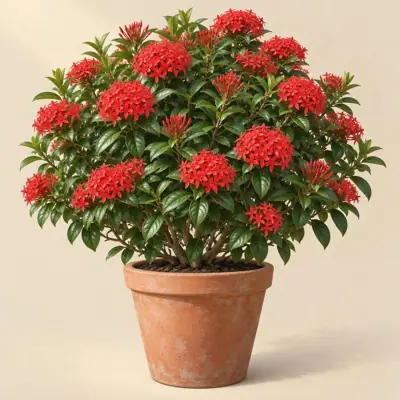
Ixora coccinea is an evergreen, woody, densely branching shrub with a compact habit that can be rounded. It is reported to be perennial.
Overview
Ixora coccinea is an evergreen, woody, densely branching shrub with a compact habit that can be rounded. It is reported to be perennial.
Origin and habitat
Sources differ on the native range, describing it broadly from South Asia into mainland Southeast Asia, including India, Sri Lanka, Bangladesh, Thailand, and Vietnam. It occurs in varied habitats, with records from different elevations in Sri Lanka and, as an introduced plant, in Colombia. It is a tropical plant widely cultivated as a horticultural shrub in tropical to subtropical regions, and global distribution records indicate a pantropical distribution.
Characteristics
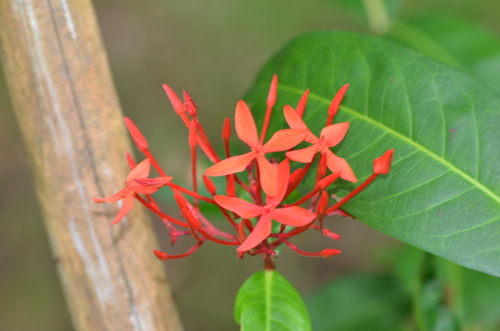
Sources differ, but mature height is reported at about 120–183 cm; based on few sources, mature spread is reported at about 91–152 cm. It is generally reported to grow quickly, with evergreen leaves that are opposite or whorled, leathery, glossy, entire, and mainly elongated-elliptic in shape. The small tubular flowers form dense terminal cymes or rounded clusters; typical flowers are bright red to scarlet, while cultivated forms also include yellow, pink, and orange flowers. Sources differ in their flowering and fruit descriptions: in warm conditions flowering can occur nearly year-round, with a principal summer flowering period also reported and intermittent bloom through the year; rounded drupes form after flowering and are described at maturity or later stages as red through deep purple or black, with each fruit capable of containing paired stones that each hold a seed.
Light
Sources differ on light preference, ranging from full sun to partial sun or partial shade; indoor plants require bright light, and full sun with some afternoon shade is also recommended.
Watering
Sources differ: regular watering with a moist but well-drained growing medium and slight drying of the surface before watering again is recommended, while another horticultural source reports high drought tolerance.
Temperature and dormancy
Based on few sources, a minimum temperature of about 10 °C is reported. USDA hardiness zones are reported for Ixora coccinea, and it is frost tender; keep above freezing.
Growing medium and mounting
It prefers fertile, organic-rich soil that stays moist while draining well, with acidic pH specifically indicated as suitable.
Feeding
Regular feeding is reported to help maintain plant health and abundant, vividly colored flowers.
Propagation
It is reported to be propagated by stem cuttings.
Common problems
Reported pests include aphids, thrips, scale insects, bagworms, nematodes, and mealybugs, with scale insects, thrips, and mealybugs also reported as more likely when plants overwinter indoors. Excessive pruning may reduce flowering, and outdoor cultivation is limited in cool regions. It is sensitive to cold and frost and should be protected from freezing; cold conditions can be poorly tolerated and freezing can kill above-ground growth, while tolerance of salt-laden sea winds is also reported. Sooty mold and fungal root rot are generally reported as possible diseases.
Identification
Ixora coccinea can be recognized as a compact, densely branching evergreen shrub with leathery, glossy leaves and many small tubular flowers gathered into conspicuous rounded clusters of bright red flowers.
Photos


Sources
- GBIF Backbone: Ixora coccinea Comm. ex Lam. — CC BY 4.0 · link
- Wikipedia (en): Ixora coccinea — CC BY-SA 4.0 · link
- Wikipedia (de): Ixora coccinea — CC BY-SA 4.0 · link
- Wikipedia (es): Ixora coccinea — CC BY-SA 4.0 · link
- GBIF descriptions: Especies introducidas, exóticas, trasplantadas, invasoras y potencialmente invasoras obtenidas a par — per dataset · link
- NC State Plant Toolbox: Ixora coccinea — copyright (facts only) · link
- Wikipedia (nl): Pauwenkers — CC BY-SA 4.0 · link
- Useful Tropical/Temperate Plants: Ixora coccinea — CC BY-NC-SA 3.0 (facts only) · link
- USDA PLANTS Database: Ixora coccinea — Public domain (US Government work) · link
- Top Tropicals catalog: Ixora coccinea — © Top Tropicals LLC (facts only) · link