
Japanese jasmine (Jasminum mesnyi)
Jasminum mesnyi is described as a woody evergreen shrub with long, slender, trailing branches and a sprawling or climbing habit when supported; sources differ in their descriptions. It is perennial and usually evergreen, but may be deciduous under some climatic conditions; sources differ.
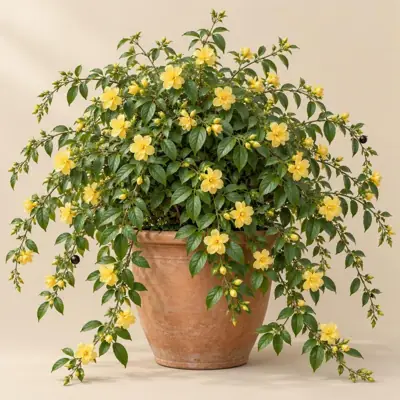
Overview
Jasminum mesnyi is described as a woody evergreen shrub with long, slender, trailing branches and a sprawling or climbing habit when supported; sources differ in their descriptions. It is perennial and usually evergreen, but may be deciduous under some climatic conditions; sources differ.
Origin and habitat
Sources differ on its native range, which is reported from southwestern to southern parts of south-central China and Vietnam, with Chinese records including Guizhou, Sichuan, and Yunnan. Chinese sources record it in gorges and forests, while another database also associates it with introduced populations in built environments. Its main growing environment is subtropical.
Characteristics
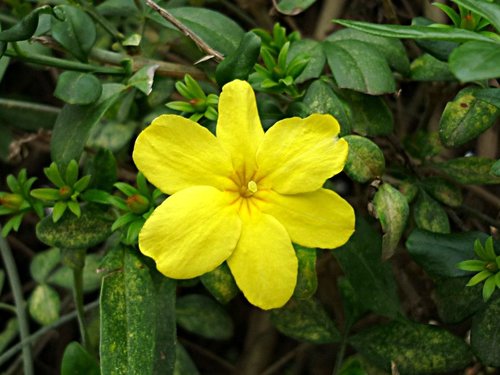
Sources differ on mature size, with height reported at about 150–300 cm and spread at about 100–150 cm. It is reported to grow rapidly and can form a denser shrub after pruning. The glossy, opposite leaves are usually divided into several leaflets; the leaflets range from ovate to elliptic, with descriptions also including lanceolate or nearly round forms, and simple leaves may occur near the base of the branches. The fragrant flowers are yellow to pale yellow and are commonly semi-double in cultivated forms, though single and double forms also occur; flowers are usually borne singly on short axillary shoots, and flowering is mainly in spring but may continue or occur sporadically into summer, with marked climatic variation in timing.
Light
It grows in full sun to partial shade, while indoor cultivation calls for bright light.
Watering
Water regularly, allowing the surface of the growing medium to dry slightly before watering again; the medium should drain well, and the plant has some short-term drought tolerance.
Temperature and dormancy
Sources differ, with a lower temperature of about -5 °C reported. Published hardiness classifications include USDA and RHS systems, though the qualitative claim does not establish numerical limits. It is generally reported to tolerate brief light frost.
Growing medium and mounting
It is reported to require well-drained soil and can be grown in chalk, loam, or sandy soil under acidic, neutral, or alkaline conditions.
Propagation
It is reported to be propagated by semi-hardwood cuttings or by layering in autumn.
Common problems
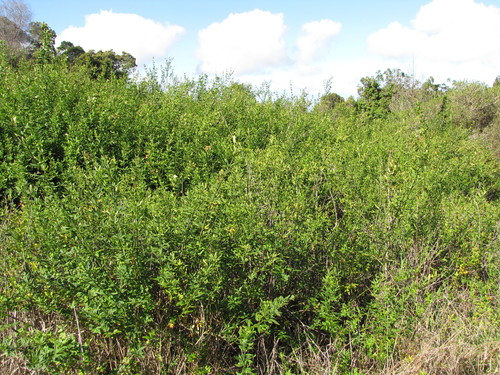
Reported pests include aphids, scale insects, and mealybugs, with spider mites also possible in greenhouse conditions. Its fast-growing, sprawling branches require regular pruning for control in confined spaces, and in some areas outside its native range it may escape cultivation. Cold tolerance is limited, favoring sheltered locations without severe frost, although mature plants may tolerate brief light frost.
Identification
Jasminum mesnyi can be distinguished by its long, arching and trailing branches, glossy green opposite leaves that are often compound with several leaflets, and conspicuous yellow semi-double flowers; the branches may be angular in cross-section.
Photos


Sources
- Wikipedia (en): Jasminum mesnyi — CC BY-SA 4.0 · link
- 維基百科:野迎春 — CC BY-SA 4.0 · link
- Wikipedia (ja): オウバイモドキ — CC BY-SA 4.0 · link
- Wikipedia (fr): Jasminum mesnyi — CC BY-SA 4.0 · link
- Wikipedia (es): Jasminum mesnyi — CC BY-SA 4.0 · link
- GBIF descriptions: Checklist of introduced taxa in Cyprus; DAISIE - Inventory of alien invasive species in Europe — per dataset · link
- Wikipedia (it): Jasminum mesnyi — CC BY-SA 4.0 · link
- RHS Plants: Jasminum mesnyi — © RHS, facts only · link
- USDA PLANTS Database: Jasminum mesnyi — Public domain (US Government work) · link
- Top Tropicals catalog: Jasminum mesnyi — © Top Tropicals LLC (facts only) · link