
goutystalk nettlespurge (Jatropha podagrica)
Jatropha podagrica is a caudiciform succulent shrub with a swollen stem base and may have the form of an upright shrub or perennial herb. Sources differ in describing its perennial life cycle.
Overview
Jatropha podagrica is a caudiciform succulent shrub with a swollen stem base and may have the form of an upright shrub or perennial herb. Sources differ in describing its perennial life cycle.
Origin and habitat
Sources differ on its native range: it is placed in tropical America, with Central America as the core range, particularly Guatemala, Honduras, and Nicaragua, while other accounts extend the range to southern Mexico, the West Indies, Colombia, or northern South America. Its habitat includes seasonally dry tropical forest; it is also widely cultivated as an ornamental and can become naturalized in some tropical regions. It is tropical, favors warm conditions, tolerates heat, and has poor tolerance of cold and frost.
Characteristics
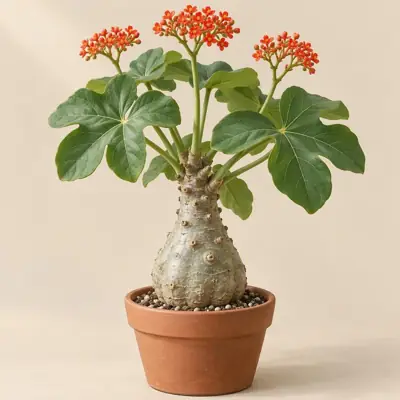
Sources differ on mature size, with height reported at about 40–150 cm and, from few sources, spread at about 10–50 cm. Leaves are concentrated near the tops of stems or branches on long, fleshy petioles; the green blades are peltate to heart-shaped and usually shallowly lobed. Small orange-red to bright red flowers occur in dense or branched terminal inflorescences held above the leaves on slender stalks, with male and female flowers in the same inflorescence; sources differ on flowering time, describing intermittent flowering through much of the year under suitable conditions, mainly from spring through autumn, or in summer. The plant has a swollen stem, and its green capsules mature to brown or dark brown before splitting open and ejecting their seeds.
Light
It grows in full sun to partial sun, while indoor container plants should receive bright light; ample sunlight supports flowering, although some cultivation sources recommend avoiding excessively intense sun.
Watering
During active growth, water moderately and allow the growing medium to dry between waterings, avoiding prolonged wetness; in cold conditions or winter, watering should be greatly reduced, with some sources recommending drier conditions in autumn and winter. While in leaf, water when the mix has dried, and water sparingly while leafless.
Humidity and airflow
It is reported to need moderate airflow.
Temperature and dormancy
Sources differ on the minimum temperature, with limited reports placing it around -1.1 °C. It has high heat tolerance and is reported to tolerate brief light frost. It drops its leaves and goes dormant, with dormancy triggered by cold. Hardiness is described in USDA zones, although the claim does not provide an exact numerical value that can be stated here.
Growing medium and mounting
It needs a fast-draining mix; loamy or sandy growing media can be used, and containers should have adequate drainage holes.
Feeding
It is generally reported to benefit from light feeding during the spring-to-autumn growing season, using a fertilizer with similar proportions of nitrogen, phosphorus, and potassium or with slightly more phosphorus.
Propagation
Jatropha podagrica can be propagated by seed or cuttings; spring and summer are suitable for sowing, and cuttings can also be taken during warm seasons. Plants raised from seed more readily develop the characteristic bottle-shaped swollen stem.
Common problems
Possible pests include mealybugs, aphids, spider mites, scale insects, thrips, and whiteflies. Sources differ on disease problems, with some reporting root rot, red leaf spot, gray mold, and southern blight, while others describe disease as generally uncommon. Overly wet growing medium can cause root problems; mature fruits can burst suddenly and eject seeds, so they may be covered with a mesh bag in advance when collecting seed. Cold tolerance is weak, drought or low temperatures can cause leaf drop, and leaves are sensitive to strong winds, favoring a sheltered position; mature plants may briefly endure temperatures near freezing, while young plants require greater cold protection.
Identification
A conspicuous identifying feature is the gray-green to gray, bottle-shaped swollen stem base marked with bumps or leaf scars, topped by large lobed leaves and coral-red to orange-red inflorescences rising above the foliage.
Photos


Sources
- Wikipedia (en): Jatropha podagrica — CC BY-SA 4.0 · link
- 維基百科:珊瑚油桐 — CC BY-SA 4.0 · link
- Wikipedia (ja): サンゴアブラギリ — CC BY-SA 4.0 · link
- Wikipedia (fr): Jatropha podagrica — CC BY-SA 4.0 · link
- Wikipedia (es): Jatropha podagrica — CC BY-SA 4.0 · link
- NC State Plant Toolbox: Jatropha podagrica — copyright (facts only) · link
- TaiCOL 臺灣物種名錄: Jatropha podagrica — CC BY 4.0 · link
- LLIFLE Encyclopedia of living forms: Jatropha podagrica — CC BY-SA · link
- RHS Plants: Jatropha podagrica — © RHS, facts only · link
- USDA PLANTS Database: Jatropha podagrica — Public domain (US Government work) · link
- Desert-Tropicals: Jatropha podagrica — © Philippe Faucon (desert-tropicals.com), facts only · link
- The Succulent Plant Page: Jatropha (genus-level) — © R.J. Hodgkiss, facts only · link
- 臺北典藏植物園 植物資料庫: Jatropha podagrica — © 臺北典藏植物園, facts only · link
- NHK みんなの趣味の園芸 植物図鑑: Jatropha podagrica — © NHK出版, facts only · link