
Chinese Juniper (Juniperus chinensis)
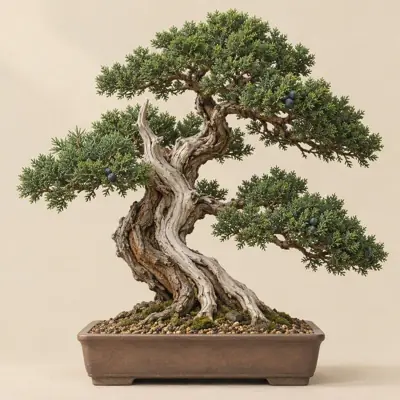
Juniperus chinensis is a perennial evergreen coniferous tree or shrub, with cultivars ranging from upright, conical, and columnar forms to spreading or low-growing forms; 'Shimpaku' is an important bonsai material.
Overview
Juniperus chinensis is a perennial evergreen coniferous tree or shrub, with cultivars ranging from upright, conical, and columnar forms to spreading or low-growing forms; 'Shimpaku' is an important bonsai material.
Origin and habitat
Sources differ on its native range: they commonly include parts of East Asia to northern Southeast Asia, including China, Japan, the Korean Peninsula, Myanmar, and the Russian Far East, while some also include Mongolia, Taiwan, or the Himalayan region; TaiCOL treats it as native to Taiwan. It occurs on coastal rocks, sandy ground, open rocky slopes, and in mountain habitats, with some alpine forms growing among rock outcrops and boulders; it can also occur in secondary vegetation. It is adapted to varied East Asian environments, including sunny, fast-draining coastal sites, and has considerable tolerance of cold and drought.
Characteristics
Sources differ on mature height, with the few sources indicating about 100–2500 cm, while mature spread is 400–800 cm; sources also differ in describing its growth rate as slow. The foliage is dimorphic: juvenile leaves are needle-like or awl-like, while mature leaves are mainly scale-like and lie close to the branches; needle-like juvenile foliage may still appear on young shoots, shaded lower branches, or pruned areas of mature plants, and foliage is usually green to dark green. It is reported to be usually dioecious, with some monoecious individuals, and to have small male cones at branch tips; sources differ on flowering records, though flowering is associated with spring. Sources differ in details of the fleshy, nearly spherical, berry-like seed cones, which become black-purple, blue-black, or dark when mature and often have a whitish or waxy coating.
Light
It grows in full sun to partial sun.
Watering
A well-drained growing medium is important; it can be kept moderately moist and watered after the surface dries, while established plants have some drought tolerance.
Temperature and dormancy
Few sources are available and they differ, but the reported minimum temperature is about -30 °C. Sources differ on the reported hardiness zone, while the plant is frost hardy.
Growing medium and mounting
Well-drained soil is important; it can adapt to sandy, loamy, clay, and chalky soils and can tolerate acidic, neutral, or alkaline conditions, although another source indicates a preference for neutral to slightly alkaline soil.
Propagation
The species can be propagated from seed, while cultivars can be grafted; RHS also recommends propagation by semi-hardwood cuttings.
Common problems
Potential pests include aphids, scale insects, conifer red spider mites, and caterpillars. Potential diseases include blight, canker, and diseases associated with honey fungus; it can also serve as an intermediate host in the life cycle of rust affecting pears and apples. Drainage and common conifer pests and diseases require attention, and growing junipers near pear- and apple-producing areas may also raise rust-management concerns. Established plants in the ground tolerate drought and cold, but potted plants in cold regions need protection from severe freezing of the potting medium and roots.
Identification
This evergreen has distinctly dimorphic foliage, with needle-like juvenile leaves and scale-like mature leaves occurring on the same plant, while its fleshy, nearly spherical seed cones often have a whitish coating. 'Shimpaku' is especially important as Japanese bonsai material and is also noted for its fine, dense foliage.
Photos


Sources
- Wikipedia (en): Juniperus chinensis — CC BY-SA 4.0 · link
- 維基百科:圓柏 — CC BY-SA 4.0 · link
- Wikipedia (ja): イブキ — CC BY-SA 4.0 · link
- Wikipedia (de): Chinesischer Wacholder — CC BY-SA 4.0 · link
- Wikipedia (fr): Genévrier de Chine — CC BY-SA 4.0 · link
- Wikipedia (es): Juniperus chinensis — CC BY-SA 4.0 · link
- GBIF descriptions: DAISIE - Inventory of alien invasive species in Europe; Chapter 7: Linnaean Plant Names and their Ty — per dataset · link
- NC State Plant Toolbox: Juniperus chinensis — copyright (facts only) · link
- Wikipedia (nl): Chinese jeneverbes — CC BY-SA 4.0 · link
- TaiCOL 臺灣物種名錄: Juniperus chinensis — CC BY 4.0 · link
- Useful Tropical/Temperate Plants: Juniperus chinensis — CC BY-NC-SA 3.0 (facts only) · link
- RHS Plants: Juniperus chinensis — © RHS, facts only · link
- USDA PLANTS Database: Juniperus chinensis — Public domain (US Government work) · link
- Top Tropicals catalog: Juniperus chinensis — © Top Tropicals LLC (facts only) · link