
Creeping Juniper (Juniperus procumbens)
Juniperus procumbens is an evergreen, low-growing, prostrate coniferous shrub and a perennial woody plant; 'Nana' is a dwarf, slow-growing, prostrate cultivar.
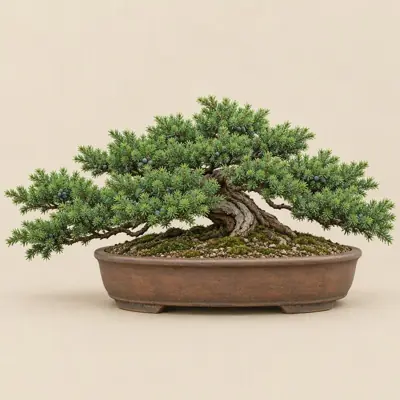
Overview
Juniperus procumbens is an evergreen, low-growing, prostrate coniferous shrub and a perennial woody plant; 'Nana' is a dwarf, slow-growing, prostrate cultivar.
Origin and habitat
The confirmed core of its native range is in southern Japan, but sources differ on the more precise wild native range: it may be restricted to Kyushu and some islands of southern Japan, while another view includes southern Japanese coasts as far as Chiba Prefecture and the southern and western coasts of the Korean Peninsula. Its wild habitat is reported differently, either as alpine environments in Kyushu and islands of southern Japan or as coastal areas of southern Japan and the southern and western Korean Peninsula.
Characteristics
Sources differ on mature height, reporting about 45.72–45.72 cm, while mature spread is 200–457.2 cm and growth is slow. It is reported to retain juvenile-type, needle-shaped leaves, generally borne in whorls, with two white stomatal bands visible on the inner or upper surface. It is reported to be dioecious, with each plant producing reproductive cones of only one sex; male cones release pollen in early spring. The female cones are reported to be nearly spherical and berry-like, becoming black to very dark black-brown at maturity with a blue-white to blue-green waxy bloom and containing multiple seeds.
Light
It is reported to prefer full sun.
Watering
It generally prefers a well-drained, relatively dry growing medium and tolerates hot, dry conditions, but does not tolerate prolonged wetness or waterlogging.
Growing medium and mounting
It is reported to adapt to various soils, including relatively poor soils, while generally favoring ordinary, well-drained soil and relatively dry sandy soil; wet, poorly drained growing media should be avoided.
Common problems
Reported pests include aphids, bagworms, twig borers, web-forming moths, spider mites, juniper bud mites, and scale insects. Junipers are reported to be susceptible to twig blights that cause shoot dieback and to rusts, while root rot may occur in wet, poorly drained soil. The main reported cultivation risks are overly wet, poorly drained growing media, which may lead to root rot, and twig blight affecting shoot tips. It is reported to tolerate hot and dry conditions and to have moderate salt tolerance.
Identification
Juniperus procumbens spreads horizontally close to the ground, with long branches that can interweave into a dense mat; its needle-shaped leaves are borne in whorls and have two conspicuous white stomatal bands. 'Nana' is additionally distinguished by its dwarf, slow-growing, prostrate form.
Photos


