
barrel cactus (Kroenleinia grusonii)
Kroenleinia grusonii is an evergreen perennial barrel-shaped cactus, usually solitary and globular to short-columnar, with older plants occasionally producing basal offsets. It is described as perennial, although sources differ.
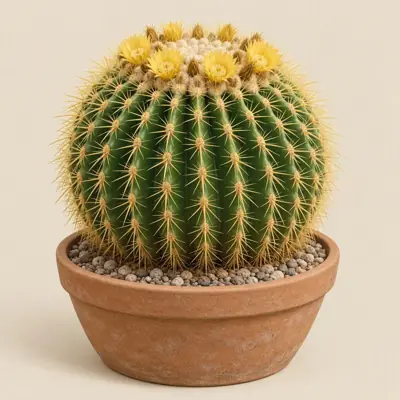
Overview
Kroenleinia grusonii is an evergreen perennial barrel-shaped cactus, usually solitary and globular to short-columnar, with older plants occasionally producing basal offsets. It is described as perennial, although sources differ.
Origin and habitat
It is native to Mexico, with Hidalgo and Querétaro forming the more consistently reported core range; sources differ on records from Zacatecas or San Luis Potosí. It occurs on moderate to steep slopes, in canyons, or on rock faces in semi-desert environments, on volcanic rock or calcareous soils. Its native environment in Mexico is semi-arid to arid and has hot summers.
Characteristics
Sources differ, but mature height is reported at about 20–130 cm; mature spread is 40–80 cm. It is described as slow-growing, although sources differ. It is reported to produce yellow flowers around the crown at the top of the plant, generally only on older plants; sources differ on the flowering season. The fruit is globular to slightly elongated, green to yellow-green and covered with white wool, and contains smooth, glossy brown seeds.
Light
Kroenleinia grusonii takes full sun and grows in a sunny position with abundant light.
Watering
During growth, avoid prolonged wetness and use a medium that drains quickly; in winter or dormancy, reduce watering until conditions are nearly dry.
Humidity and airflow
It is reported to prefer low humidity.
Temperature and dormancy
Sources are few and differ, but the reported minimum is in the range around -10 °C. It rests cool and dry in winter and tolerates brief light frost.
Growing medium and mounting
It needs well-drained, well-aerated soil and a fast-draining mix; in its natural habitat it occurs on volcanic or calcareous soils. It is not epiphytic.
Feeding
It is generally advisable to avoid excessive fertilizer because this is reported to cause the plant to split.
Propagation
It is reported to be propagated by seed.
Common problems
Excessive wetness may impair growth, while excessive fertilizer may cause the plant to split. It is unsuited to prolonged humid conditions, and seedlings have poorer cold tolerance; mature plants in their native environment can tolerate brief light frost, with some records also reporting occasional low temperatures.
Identification
Mature plants are reported to have numerous prominent ribs, strong spines that are often conspicuously golden yellow when young, both radial and central spines, and conspicuous wool at the top.
Photos

