
crapemyrtle (Lagerstroemia indica)
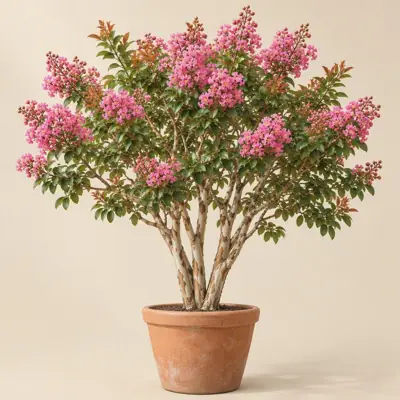
Lagerstroemia indica is a perennial, deciduous woody plant that grows as a multi-stemmed shrub to small tree, often with an upright, spreading form.
Overview
Lagerstroemia indica is a perennial, deciduous woody plant that grows as a multi-stemmed shrub to small tree, often with an upright, spreading form.
Origin and habitat
It is native to Asia, with a core range extending from southern China into South Asia, the Himalayan region, and Southeast Asia; sources differ on whether Japan, Taiwan, and the Philippines are also included. Its habitats include low-elevation open grassland, cliffs, forest edges, partly shaded sites, and fertile fields, and it is also widely cultivated in gardens, parks, and roadside green spaces. It is suited to warm-temperate, subtropical, and tropical environments, with hot summers favoring flowering, and is widely cultivated from temperate to tropical climates.
Characteristics
Sources differ on mature size, with height reported at about 200–800 cm; a limited source reports a spread of about 0–600 cm. Growth is moderate, and the small to medium-small leaves are typically elliptic, ovate, or obovate-elliptic with entire margins; mature leaves are dark green and may turn yellow, orange, or red before falling in autumn, while leaf arrangement may be opposite or alternately arranged in pairs. The terminal panicles bear flowers with distinctly crinkled or wavy-edged petals in white, pink, red, pale purple, purple, or crimson, though sources differ in their descriptions; flowering occurs mainly from summer into autumn and lasts for an extended period. The fruit is a capsule that turns brown to dark-colored and splits when mature, containing winged seeds, with fruiting reported in autumn.
Light
Full sun is preferred, while partial shade can be provided in extremely hot, dry regions.
Watering
It prefers moist, well-drained soil and can tolerate some drought after establishment; supplemental irrigation is needed in dry climates, while watering can be reduced in autumn and winter.
Humidity and airflow
It is generally reported to prefer high humidity.
Temperature and dormancy
Sources differ on the lower temperature limit, which is reported at about -10 °C. A limited source reports an ideal temperature range of about 23–30 °C. Sources differ on its USDA hardiness-zone classification, while it is frost hardy.
Growing medium and mounting
It prefers well-drained, moist, humus-rich soil but can adapt to various well-drained soils and lower-fertility conditions, and it does not favor very alkaline soil.
Feeding
It is reported that organic basal fertilizer can be applied before establishment, followed from late spring by regular applications of a flower fertilizer higher in phosphorus and potassium to promote summer flowering.
Propagation
It can be propagated by seed, cuttings, and layering; autumn-collected seed can be sown in spring, and cuttings can be taken from vigorous established branches or from semi-woody material.
Common problems
Reported pests include crape myrtle aphids, crape myrtle flea beetles, and crape myrtle bark scale. It is reported that insufficient summer heat can weaken flowering and increase susceptibility to fungal diseases. In cold regions, above-ground growth may die back in winter, and insufficient summer heat may impair flowering; in some regions, plants escaping cultivation can become naturalized and may even be classified as invasive. Young plants and plants in cold regions can be sensitive to low temperatures and winter winds; hot summers favor flowering, while extremely dry, hot regions require additional water and may benefit from some shade.
Identification
It is reported to have smooth bark that peels in patches, producing a mottled trunk with contrasting tones, together with crinkled petals, an extended flowering period, and deciduous leaves that change color in autumn.
Photos


Sources
- Wikipedia (en): Lagerstroemia indica — CC BY-SA 4.0 · link
- 維基百科:紫薇 — CC BY-SA 4.0 · link
- Wikipedia (ja): サルスベリ — CC BY-SA 4.0 · link
- Wikipedia (fr): Lagerstroemia indica — CC BY-SA 4.0 · link
- Wikipedia (es): Lagerstroemia indica — CC BY-SA 4.0 · link
- GBIF descriptions: Lista de especies de plantas exóticas y trasplantadas de Colombia; Catálogo de Plantas y Líquenes de — per dataset · link
- NC State Plant Toolbox: Lagerstroemia indica — copyright (facts only) · link
- Wikipedia (it): Lagerstroemia indica — CC BY-SA 4.0 · link
- Wikipedia (ko): 배롱나무 — CC BY-SA 4.0 · link
- 農業知識入口網 植物圖鑑: Lagerstroemia indica — © MOA, facts only · link
- Useful Tropical/Temperate Plants: Lagerstroemia indica — CC BY-NC-SA 3.0 (facts only) · link
- USDA PLANTS Database: Lagerstroemia indica — Public domain (US Government work) · link
- Top Tropicals catalog: Lagerstroemia indica — © Top Tropicals LLC (facts only) · link