
summer snowflake (Leucojum aestivum)
Leucojum aestivum is a bulbous perennial herb with an underground bulb as its persistent organ and can form clumps.
Overview
Leucojum aestivum is a bulbous perennial herb with an underground bulb as its persistent organ and can form clumps.
Origin and habitat
Its native range extends mainly from Europe to western Asia, including parts of Europe, Turkey, Anatolia and the Caucasus, and eastward to northern Iran; sources differ on whether peripheral areas such as Britain and Ireland are native. It favors moist environments and occurs in wet grassland, marshes, ditches, river deltas, moist woodland or willow scrub, and damp shaded places subject to periodic flooding.
Characteristics
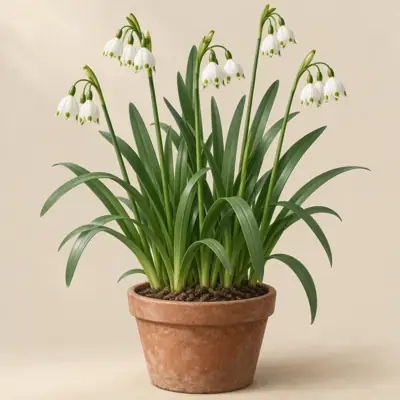
Mature plants reach 35–60 cm in height; a single source reports a spread of about 0–10 cm, so evidence for the spread is limited. The leaves are narrow and linear to strap-shaped, are fully developed by flowering, and can approach the flower stems in height. The flowers are nodding and bell-shaped, with white tepals of similar size bearing green spots near their tips; several flowers are borne together on stalks of varying lengths, though sources differ in their descriptions. Flowering is mainly in spring, though sources differ in describing its timing; capsules contain multiple black seeds, and the fruit is reported to develop air spaces that aid flotation and may permit dispersal by water during floods.
Light
Leucojum aestivum grows in full sun to partial sun, needs light during active growth, and can also tolerate some shade.
Watering
Keep conditions consistently moist during active growth; it suits moist, well-drained soil but can also tolerate clay and very wet or waterlogged conditions. During summer dormancy, it can tolerate drier conditions.
Temperature and dormancy
A single source reports a minimum temperature of about -5 °C, so evidence is limited. A single source reports its hardiness classification as H7.
Growing medium and mounting
It suits moist soil rich in organic matter and humus and can grow in loam and clay, with multiple sources indicating tolerance of heavy clay. Sources differ on its suitability for acidic soil.
Propagation
It can be propagated from seed or by separating offsets after the leaves die back, and plants also gradually form clumps through bulb division. Seed-propagated plants usually take several years to flower.
Common problems
Slugs, snails and narcissus bulb fly may cause damage, while disease is generally reported to be uncommon. Consistent moisture is needed during active growth, and sources differ on whether acidic soil is suitable; escaped plants may become invasive in some areas, with NC State identifying it as invasive in Delaware, United States. It tolerates wet and periodically flooded conditions, requiring continuing moisture during active growth while tolerating drier conditions during summer dormancy. Flooding can break flower stems and transport fruits, and may wash bulbs onto riverbanks.
Identification
The nodding, bell-shaped white flowers have tepals of similar size, each with a green spot near its tip, and a flower stem typically bears several flowers at once; these features distinguish it from similar-looking snowdrops and spring snowflake.
Photos


Sources
- Wikipedia (en): Leucojum aestivum — CC BY-SA 4.0 · link
- Wikipedia (ja): スノーフレーク (ヒガンバナ科) — CC BY-SA 4.0 · link
- Wikipedia (de): Sommer-Knotenblume — CC BY-SA 4.0 · link
- Wikipedia (fr): Nivéole d'été — CC BY-SA 4.0 · link
- Wikipedia (es): Leucojum aestivum — CC BY-SA 4.0 · link
- GBIF descriptions: Database of Vascular Plants of Canada (VASCAN); DAISIE - Inventory of alien invasive species in Euro — per dataset · link
- NC State Plant Toolbox: Leucojum aestivum — copyright (facts only) · link
- Useful Tropical/Temperate Plants: Leucojum aestivum — CC BY-NC-SA 3.0 (facts only) · link
- RHS Plants: Leucojum aestivum — © RHS, facts only · link
- USDA PLANTS Database: Leucojum aestivum — Public domain (US Government work) · link