
Lilium hybrid (Lilium hybrid)
Lilium hybr is reported to be an upright, usually unbranched bulbous herb with an underground bulb composed of fleshy scales. It is reported to be a perennial herb.
Overview
Lilium hybr is reported to be an upright, usually unbranched bulbous herb with an underground bulb composed of fleshy scales. It is reported to be a perennial herb.
Origin and habitat
The native range of the genus Lilium is reported to extend widely across the Northern Hemisphere, including Europe, Asia to Japan, India, Indochina and the Philippines, as well as North America from southern Canada into many parts of the United States. Native lilies are reported to occur commonly in woodland, mountain and grassland habitats, with a few occurring in marsh environments; in cultivation, well-drained conditions are suitable. They are reported to be mainly adapted to temperate climates, with distributions extending into subtropical areas, and are also cultivated horticulturally in temperate, subtropical and tropical regions.
Characteristics
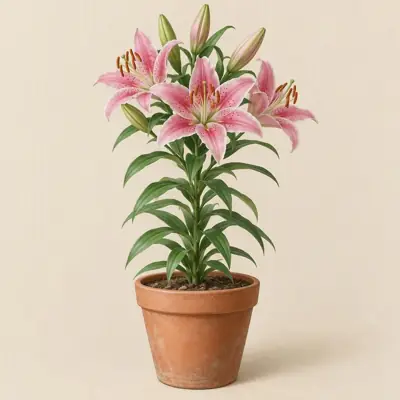
Sources differ, but mature height is reported at about 30–180 cm. The stems are reported to bear sessile leaves; leaf arrangement and appearance vary among horticultural groups, and some groups have whorled leaves. Flowers are reported to be generally large and conspicuous, with tepals that may face upward or outward or be pendent; forms include trumpet-shaped, bowl-shaped and star-shaped flowers or flowers with strongly recurved tepals, while colors include white, yellow, orange, pink, red and purple, sometimes with spots or brush-like markings, and fragrance varies among hybrid groups. Flowering is reported to occur mainly from late spring through summer and may continue into early autumn in different kinds or horticultural groups; the fruit is reported to be a three-chambered capsule, with seeds usually maturing in late summer.
Light
Lilium hybr is reported to suit full sun to partial shade, with NC State recommending full sun to afternoon sun for the foliage while keeping the root zone cooler.
Watering
During the growing season, it is reported to need watering without allowing the soil to dry out completely, while prolonged excessive moisture should be avoided because standing water and poor drainage may cause bulb rot.
Temperature and dormancy
Lilium hybr is reported to be frost hardy.
Growing medium and mounting
Well-drained, fertile and loose soil is reported to be preferable; most lilies suit porous loam and generally prefer slightly acidic soil or soil without excessive lime.
Propagation
Lilium hybr is reported to be propagated by bulb division, stem bulbils, scales, seed, or micropropagation such as tissue culture; commercial production commonly uses in vitro propagation.
Common problems
Reported pests include aphids, bulb mites, slugs, snails, leatherjackets and lily leaf beetle larvae, while mice, deer and squirrels may also feed on the plants. Reported diseases include Botrytis-associated lily leaf blight, bulb rot, and viral diseases such as aphid-transmitted lily mosaic virus; some viral infections may cause mottled leaves and suppressed growth. Overly wet soil or poor drainage is reported to make bulb rot more likely, while heavy flower clusters or taller plants may require staking.
Identification
Lilium hybr is reported to have an underground scaly bulb and a usually upright habit; its flowers have tepals with central nectar-bearing grooves, and the anthers are dorsifixed and able to swing.