
Aucamps Living Stone (Lithops aucampiae)
Lithops aucampiae is a small, nearly stemless, clump-forming perennial succulent whose body is mostly buried in the soil. It is perennial, with old paired leaves replaced by new paired leaves as part of its annual growth cycle.
Overview
Lithops aucampiae is a small, nearly stemless, clump-forming perennial succulent whose body is mostly buried in the soil. It is perennial, with old paired leaves replaced by new paired leaves as part of its annual growth cycle.
Origin and habitat
Sources differ in their accounts of its native range, with South Africa reported as its origin. It inhabits sandy, dry desert environments, often scattered among ironstone, sandstone, flint, quartzite, and rocky gravel; plants may be covered by sand and camouflaged among surrounding stones. Its environment is dry and ranges from warm-temperate South African conditions to desert conditions, with some localities in summer-rainfall areas.
Characteristics
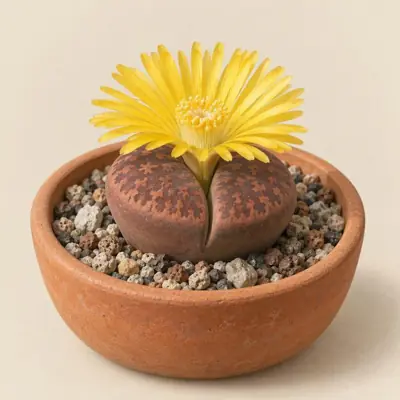
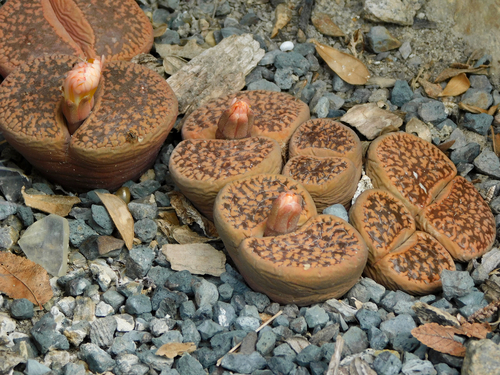
Few sources report a mature height of about 0–10 cm and a mature spread of about 0–10 cm, and it grows slowly. The plant mainly consists of a pair of thick, fleshy leaves with flattened tops, translucent windows, and a fissure between them; sources differ on their description of the leaves, which range in color from reddish brown and ochre to brownish gray and bear darker, highly variable markings. It stores water in its leaves and produces yellow, daisy-like flowers from the fissure between the leaves; sources differ on the flowering period, described as around late summer to autumn, with yellow autumn flowers considered typical. The capsule is reported to have multiple chambers; it opens when wet to expose small seeds and closes again when dry.
Light
Lithops aucampiae takes full sun and can also be grown in bright light; in greenhouse cultivation, bright filtered light with ventilation can be used.
Watering
Sources differ on watering details, but describe low water needs and advise avoiding overwatering; moderate watering can be given during growth, while conditions should remain dry from after flowering until the old leaves have been fully replaced by new ones and nearly dry in winter.
Humidity and airflow
It is reported to need good airflow.
Temperature and dormancy
Few sources report an ideal temperature range of about 8–25 °C and a maximum of about 35 °C. It is reported to tolerate brief light frost, with few sources reporting a cold minimum of about -7 °C. It rests in summer. As temperatures rise and summer dormancy begins, it is reported to benefit from a shaded, well-ventilated position with reduced watering.
Growing medium and mounting
A very well-drained cactus or succulent medium is suitable, preferably mineral, sandy, or gravelly and relatively nutrient-poor; loam and sand are both listed as suitable, with acidic, neutral, or alkaline conditions possible. Lithops aucampiae is reported to be prone to rot and to need a very fast-draining mix.
Feeding
Feed lightly during the growing period, using either a balanced liquid fertilizer or a slow-release fertilizer.
Propagation
Lithops aucampiae can be propagated by seed or by division or separation of offsets.
Common problems
Possible pests include aphids, scale insects, mealybugs, and root mealybugs; genus-level information also mentions feeding by slugs and moth larvae. Disease problems are generally uncommon, but spent flowers remaining wet for prolonged periods may increase the risk of rot. Poor drainage or excessive moisture is reported to cause root rot, while excessive moisture may also split the epidermis and leave scars. It should be protected from winter wet and is suited to a drier, sheltered position.
Identification
Lithops aucampiae resembles gravel, with a body formed by a pair of thick leaves separated by a central fissure; the tops have translucent windows and complex brown to reddish-brown markings, and the flowers are yellow.
Photos



Sources
- GBIF Backbone: Lithops aucampiae L.Bolus — CC BY 4.0 · link
- Wikipedia (en): Lithops aucampiae — CC BY-SA 4.0 · link
- 維基百科:日輪玉 — CC BY-SA 4.0 · link
- Wikipedia (fr): Lithops aucampiae — CC BY-SA 4.0 · link
- Wikipedia (es): Lithops aucampiae — CC BY-SA 4.0 · link
- LLIFLE Encyclopedia of living forms: Lithops aucampiae — CC BY-SA · link
- RHS Plants: Lithops aucampiae — © RHS, facts only · link
- Desert-Tropicals: Lithops aucampiae — © Philippe Faucon (desert-tropicals.com), facts only · link
- The Succulent Plant Page: Lithops (genus-level) — © R.J. Hodgkiss, facts only · link
- Terry Smale — Growing Lithops: Lithops (genus-level) — © Terry Smale, facts only · link
- NHK みんなの趣味の園芸 植物図鑑: Lithops aucampiae — © NHK出版, facts only · link
- NC State Plant Toolbox: Lithops (genus-level) — copyright (facts only) · link
- Lithops aucampiae | Giromagi cactus and succulents for sale | Buy plants online (www.giromagi.com) — facts only (§12) · link
- PUKUBOOK: Lithops aucampiae — CC BY-NC (facts only) · link