
Lithops lesliei (Lithops lesliei)
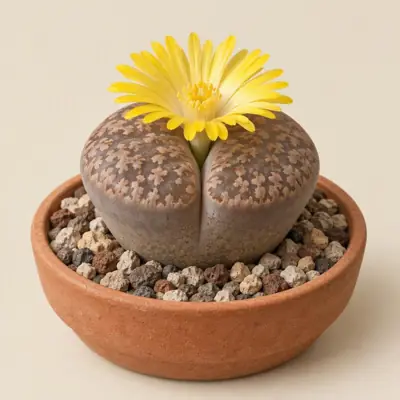
Lithops lesliei is a nearly stemless perennial succulent, usually consisting of a pair of highly fleshy leaves and occurring either singly or in clumps of multiple bodies.
Overview
Lithops lesliei is a nearly stemless perennial succulent, usually consisting of a pair of highly fleshy leaves and occurring either singly or in clumps of multiple bodies.
Origin and habitat
Sources differ on its native range, describing it as occurring in South Africa and southeastern Botswana, with a broad South African distribution including the Free State, Gauteng, Northern Cape and North West, roughly extending through the Vaal River basin. It grows in rocky and gravelly parts of grassland and savanna, including gravelly depressions among grasses and rocky settings; plants are often embedded in the soil, may occur in the shade of other plants, and can blend into surrounding gravel. Its native range is mainly in summer-rainfall areas; some localities receive relatively high rainfall, but plants still occupy well-drained rocky and gravelly microhabitats.
Characteristics
Few sources report dimensions; mature plants are reported to reach about 0–10 cm in height and about 0–10 cm in spread. Each body consists mainly of a closely joined pair of thick, fleshy leaves that store water, with a central fissure at the top; the top is roughly flat to slightly convex and often bears dark green, irregular, sometimes interconnected translucent window patterns, while side and top colors vary markedly among individuals and localities, and old leaves shrivel as a new pair gradually replaces them. Large flowers emerge from the fissure between the leaves and are mainly yellow but may be white, with white flowers less common; sources differ on flowering time, describing it mainly in autumn, from late summer into autumn, or in April in native-habitat records. The fruit is generally reported by a specialist source to have multiple chambers, and the plant grows slowly.
Light
Sources differ on light guidance: horticultural cultivation emphasizes full sun or bright, strong light, while some general Lithops guidance recommends morning sun with moderate afternoon shade; another source describes bright light or part shade.
Watering
Water needs are low; during active growth, allow the growing medium to dry thoroughly after watering before watering again, stop watering after flowering until the old leaves have completely shriveled and been replaced by new leaves, and do not water during dormancy.
Humidity and airflow
It is reported to need good airflow.
Temperature and dormancy
Single sources report a minimum and an ideal temperature range, but these qualitative claims do not establish numerical values; it is also reported to tolerate brief light frost and is listed as RHS H2. It is reported to rest in summer. A specialist source reports tolerance of extreme heat in the native environment but says still greater heat is lethal; the same limited evidence places the upper limit at about 60 °C.
Growing medium and mounting
The growing medium must drain well, preferably an open, mineral-rich sandy or gritty medium; RHS also recommends adding extra grit to a loam-based medium. Lithops lesliei needs a fast-draining mix and is generally reported to be prone to rot.
Feeding
Small amounts of fertilizer may be applied during active growth; RHS recommends balanced liquid fertilizer several times during the growing season, while genus-level Lithops guidance also recommends small amounts of slow-release or liquid fertilizer during growth from autumn to spring.
Propagation
Lithops lesliei can be propagated by seed or division; RHS recommends sowing seed in spring or propagating from offsets.
Common problems
Mealybugs may occur, while genus-level Lithops information also lists scale insects, aphids, root mealybugs, slugs and noctuid larvae as pests. RHS reports that diseases are generally uncommon, but poor drainage can create a risk of root rot and spent flowers may increase rotting problems in damp conditions. A specialist source reports that excessive watering or poor management may cause root rot, excess moisture may split the epidermis and leave scars, and overly large containers may result in poorer flowering. A source advises protecting the plant from freezing; general Lithops guidance also calls for good ventilation and reduced watering during hot-weather dormancy.
Identification
A complex network-like pattern formed by many tiny, nearly circular translucent windows on the upper surface is one identifying feature; body color and upper-surface pattern vary markedly by locality, and the plant can blend with surrounding gravel.
Photos


Sources
- Wikipedia (en): Lithops lesliei — CC BY-SA 4.0 · link
- 維基百科:紫勋系 — CC BY-SA 4.0 · link
- Wikipedia (fr): Lithops lesliei — CC BY-SA 4.0 · link
- LLIFLE Encyclopedia of living forms: Lithops lesliei — CC BY-SA · link
- RHS Plants: Lithops lesliei — © RHS, facts only · link
- The Succulent Plant Page: Lithops (genus-level) — © R.J. Hodgkiss, facts only · link
- Terry Smale — Growing Lithops: Lithops (genus-level) — © Terry Smale, facts only · link
- NHK みんなの趣味の園芸 植物図鑑: Lithops (genus-level) — © NHK出版, facts only · link
- NC State Plant Toolbox: Lithops (genus-level) — copyright (facts only) · link
- Lithops lesliei | Giromagi cactus and succulents for sale | Buy plants online (www.giromagi.com) — facts only (§12) · link
- PUKUBOOK: Lithops lesliei — CC BY-NC (facts only) · link