
sweet alyssum (Lobularia maritima)
Lobularia maritima is a low-growing, highly branched herb that can form creeping or mat-like clumps. It is an annual herb that may also be a short-lived perennial; in Taiwan cultivation it is usually grown as an annual cool-season flowering plant.
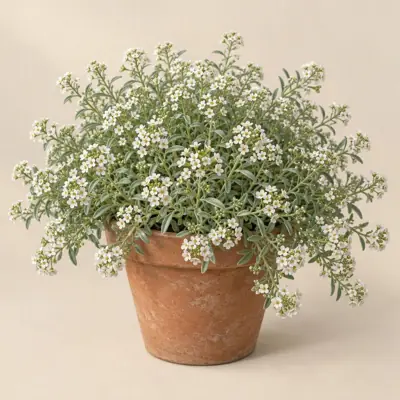
Overview
Lobularia maritima is a low-growing, highly branched herb that can form creeping or mat-like clumps. It is an annual herb that may also be a short-lived perennial; in Taiwan cultivation it is usually grown as an annual cool-season flowering plant.
Origin and habitat
Sources differ on its native range: accounts center it on the Mediterranean region and include Macaronesia, while some also include western Asia or a broader part of temperate Asia; it is now naturalized in many temperate regions worldwide. It commonly occurs along coasts, beaches, dunes and rocky shores, as well as on dry walls, slopes, roadsides, cultivated land and wasteland, and favors well-drained soils that are often calcareous. It is adapted to Mediterranean and temperate environments and tolerates dry and coastal conditions; flowering can last a long time in frost-free regions, while in Taiwan it is suited to use as a cool-season flowering plant and does not tolerate hot weather well.
Characteristics
Sources differ on mature height, placing it at about 5–30 cm, while a single source reports a mature spread of about 20–30 cm. It grows quickly and has alternate, simple, usually sessile leaves with entire margins; the leaves range from narrowly lance-shaped and linear to ovate and are often hairy, giving them a gray-green or whitish appearance. Sources differ in some flower descriptions, but describe numerous small flowers with petals, mainly white, with cultivated forms also occurring in pink, deep pink, purple or violet; the flowers are fragrant, often described as honey-scented, and densely grouped in inflorescences. Flowering is prolonged, commonly lasting from spring until before frost in temperate regions, extending to nearly year-round in Mediterranean or frost-free regions, and occurring mainly from late winter through spring according to Taiwan sources; the fruit is reported to be a small, nearly round, ovate to obovate pod, with differing source descriptions of its seeds.
Light
Full sun is preferred, though it tolerates partial sun; in hot regions, some afternoon shade can help maintain growth and flowering.
Watering
Use well-drained soil and maintain suitable moisture; the plant tolerates drought and relatively dry soil, but poor drainage can cause root rot.
Temperature and dormancy
A single source reports an ideal temperature range of about 15–25 °C, so sources are few.
Growing medium and mounting
Well-drained soil is preferred, and the plant can adapt to sandy, loamy, clay and chalky soils; in the wild it commonly occurs on sandy or calcareous substrates.
Feeding
A single source reports that during flowering, a flower fertilizer with a relatively high proportion of phosphorus and potassium may be applied to promote flowering.
Propagation
It is propagated by seed, either by direct sowing or by raising seedlings first; Taiwan sources recommend autumn sowing and give germination guidance, while other sources also report spring sowing.
Common problems
Thrips, aphids and plant-feeding insects such as Nyzius and Stictopleurus are reported to occur, although the source generally describes their numbers as low. Poor drainage can lead to root rot, while hot summers can reduce flowering; in Taiwan, high temperatures and the plum-rain season may cause plants to decline. The plant has some tolerance of drought and heat, but sustained high temperatures reduce flowering; Taiwan sources particularly describe weak heat tolerance and possible death during the plum-rain season, while frost-free conditions can extend flowering.
Identification
Lobularia maritima is low-growing and densely branched, with often-hairy leaves and many small flowers clustered at branch tips; in full bloom it forms dense white or colorful flower carpets and often has a noticeable fragrance.
Photos


Sources
- Wikipedia (en): Lobularia maritima — CC BY-SA 4.0 · link
- 維基百科:香雪球 — CC BY-SA 4.0 · link
- Wikipedia (de): Strand-Silberkraut — CC BY-SA 4.0 · link
- Wikipedia (fr): Alysson maritime — CC BY-SA 4.0 · link
- Wikipedia (es): Lobularia maritima — CC BY-SA 4.0 · link
- GBIF descriptions: Manual of the Alien Plants of Belgium; Checklist of introduced taxa in Cyprus; Database of Vascular — per dataset · link
- NC State Plant Toolbox: Lobularia maritima — copyright (facts only) · link
- 農業知識入口網 植物圖鑑: Lobularia maritima — © MOA, facts only · link
- Useful Tropical/Temperate Plants: Lobularia maritima — CC BY-NC-SA 3.0 (facts only) · link
- RHS Plants: Lobularia maritima — © RHS, facts only · link
- USDA PLANTS Database: Lobularia maritima — Public domain (US Government work) · link