
Chinese fringe flower (Loropetalum chinense)
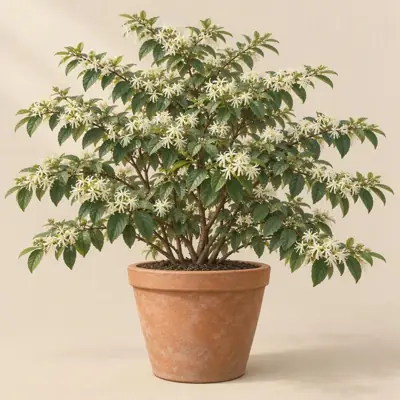
Loropetalum chinense is an evergreen to semi-evergreen shrub or small tree with many branches that may form horizontal layers or spread in arching, drooping forms.
Overview
Loropetalum chinense is an evergreen to semi-evergreen shrub or small tree with many branches that may form horizontal layers or spread in arching, drooping forms.
Origin and habitat
It is native from East Asia into Southeast Asia and northeastern India, including southern China, Japan, Taiwan, northeastern India, and parts of Southeast Asia; TaiCOL treats the Taiwan population as native. It occurs in hills, mountains, woodlands, scrub, rocky hills, drier open woodland, stream banks, slopes, and roadsides, and Chinese accounts also record it beneath Masson pine and Chinese fir forests. It is native to warm-temperate and warmer regions and can be cultivated into tropical areas; in cold regions, protection from cold winds and winter conditions is advised.
Characteristics
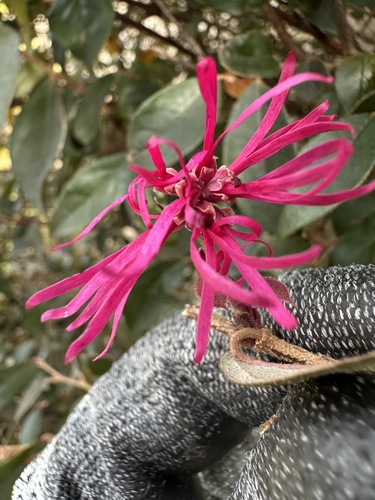
Sources differ on mature height, giving a range of about 150–610 cm; mature spread is 180–400 cm. It is reported to grow slowly, with alternate evergreen leaves that are ovate to elliptic and may have a slightly rough or frosted texture; typical forms are mostly green-leaved, while new leaves of red-flowered forms may be copper-red to red before maturing to olive green or burgundy depending on the selection and environment. The clustered flowers have slender, strap-like petals; typical forms have white to pale yellow flowers, while red-flowered forms range from pink to red, and some sources describe a light or sweet fragrance. Sources differ on flowering time, describing it as occurring from late winter through spring; the woody capsules have stellate hairs, and the seeds are elongated and ovate.
Light
Sources differ somewhat on light: full sun to partial sun is described, with ample sun favoring foliage color and flowering, while some horticultural sources recommend some afternoon shade.
Watering
It prefers moist but well-drained soil; additional water may be needed during dry summer conditions, while established plants have some drought tolerance and are unsuited to waterlogged conditions.
Temperature and dormancy
Sources differ on minimum temperature, with limited evidence indicating about -5 °C. It is generally reported to have a USDA hardiness classification extending across several zones.
Growing medium and mounting
It prefers fertile, humus-rich, moist but well-drained acidic to neutral soil and can adapt to clay, loam, and sandy soils, but does not tolerate alkaline, waterlogged, or shallow chalky soil.
Feeding
Fertilizing each year is reported to encourage growth.
Propagation
It can be propagated by seed, cuttings, and layering; seed may be sown in a warm environment from late winter to early spring, semi-ripe cuttings may be taken in summer, and layering may be done in spring.
Common problems
It is generally reported to have few notable pest problems and few notable disease problems. Leaves may yellow in overly alkaline soil, and the plant is unsuited to waterlogged or shallow chalky soil. In cold regions it needs protection from winter winds and added protection around the roots or plant, while additional water may be needed during summer drought.
Identification
Its most distinctive features are clustered flowers with slender, strap-like petals and alternate evergreen leaves; some horticultural forms combine pink to red flowers with copper-red, purplish-red, or burgundy foliage.
Photos


Sources
- Wikipedia (en): Loropetalum chinense — CC BY-SA 4.0 · link
- 維基百科:檵木 — CC BY-SA 4.0 · link
- Wikipedia (ja): トキワマンサク — CC BY-SA 4.0 · link
- Wikipedia (fr): Loropetalum chinense — CC BY-SA 4.0 · link
- NC State Plant Toolbox: Loropetalum chinense — copyright (facts only) · link
- TaiCOL 臺灣物種名錄: Loropetalum chinense — CC BY 4.0 · link
- Useful Tropical/Temperate Plants: Loropetalum chinense — CC BY-NC-SA 3.0 (facts only) · link
- RHS Plants: Loropetalum chinense — © RHS, facts only · link