
Black Jewel Orchid (Ludisia discolor)
Ludisia discolor is a terrestrial perennial orchid with creeping rhizomes and a creeping to upright habit, with records of growth on rocky substrates. It is an evergreen perennial herb.
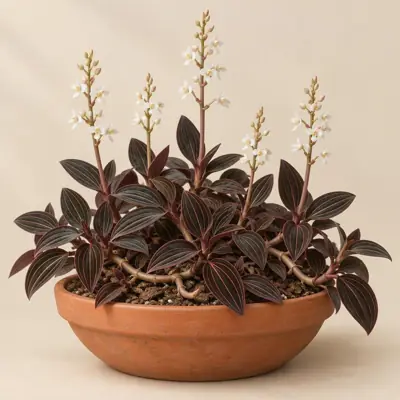
Overview
Ludisia discolor is a terrestrial perennial orchid with creeping rhizomes and a creeping to upright habit, with records of growth on rocky substrates. It is an evergreen perennial herb.
Origin and habitat
Sources differ on its native range, describing tropical to subtropical parts of Asia including the Himalayas or northeastern India, southern China, Taiwan, Myanmar, Laos, Thailand, Cambodia, Vietnam, Malaysia, Indonesia including Sumatra and the region from Borneo to Java, and the Philippines. It is reported from shaded, moist forest floors, including well-watered sites in evergreen forest, moist forest along rivers, and some habitats with rocky substrates. It favors hot to warm, highly humid environments.
Characteristics
Sources differ and are few, placing mature height and spread at about 10–50 cm. Growth is generally reported to be moderate. The leaves have a velvety texture, are often dark green to deep purplish brown or dark burgundy, and have conspicuous red, pink, or gold veins; they may be elliptic-lanceolate. Sources differ in describing the small white flowers, which are borne in upright inflorescences and have a twisted column with a yellow structure, and they also differ in reporting spring as the flowering season.
Light
Low to medium light, with partial shade, shade, or deep shade, is suitable; overly strong light may fade the dark green leaves and reveal more pale red coloration. Medium light is also indicated.
Watering
The growing medium should drain well, and watering can be regular without leaving it persistently waterlogged; sources differ between keeping it moist, watering it amply throughout the year, and letting the medium dry between waterings. It is also generally reported that you should let it dry between waterings.
Humidity and airflow
Ludisia discolor prefers high humidity and needs good airflow.
Temperature and dormancy
It is generally reported as RHS H1A. It is warm-growing.
Growing medium and mounting
It needs a well-drained, airy medium; cited options include loam, humus-rich soil, fine tree-fern fiber, general terrestrial orchid medium or fine fir bark, as well as peat-free houseplant medium or medium-coarse bark with a small amount of sphagnum moss. It is terrestrial and prefers a terrestrial mix.
Feeding
Orchid fertilizer can be applied regularly during the growing season, with sources recommending frequent feeding.
Propagation
It is reported to be propagated from fleshy stems that are broken or cut off, placed in sphagnum moss to root, and then transferred to potting medium after roots develop.
Common problems
Possible pests include aphids, mealybugs, thrips, and greenhouse red spider mites. Persistently wet medium can cause root or stem rot; sources also differ in reports of powdery mildew and stem rot caused by Fusarium oxysporum. Overly strong light may fade the dark green leaves and produce more pale red coloration. It favors warm, highly humid, shaded conditions and does poorly in strong direct sunlight; RHS lists it as H1A and suitable as an indoor, greenhouse, or warm glasshouse plant.
Identification
Its principal ornamental feature is its dark, nearly velvety foliage with red or gold veins; it is a terrestrial jewel orchid noted for its foliage.
Photos


Sources
- Wikipedia (en): Ludisia — CC BY-SA 4.0 · link
- 維基百科:血葉蘭 — CC BY-SA 4.0 · link
- Wikipedia (en): Ludisia discolor — CC BY-SA 4.0 · link
- Wikipedia (ja): ホンコンシュスラン — CC BY-SA 4.0 · link
- Wikipedia (de): Ludisia discolor — CC BY-SA 4.0 · link
- Wikipedia (fr): Ludisia discolor — CC BY-SA 4.0 · link
- Wikipedia (es): Ludisia discolor — CC BY-SA 4.0 · link
- NC State Plant Toolbox: Ludisia discolor — copyright (facts only) · link
- TaiCOL 臺灣物種名錄: Ludisia discolor — CC BY 4.0 · link
- RHS Plants: Ludisia discolor — © RHS, facts only · link
- IOSPE PHOTOS (www.orchidspecies.com) — facts only (§12) · link