
Banana magnolia (Magnolia figo)
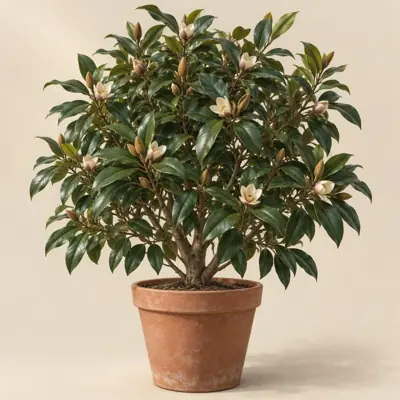
Magnolia figo is a perennial evergreen woody plant, growing as a dense shrub to small tree and forming a rounded or oval crown.
Overview
Magnolia figo is a perennial evergreen woody plant, growing as a dense shrub to small tree and forming a rounded or oval crown.
Origin and habitat
Magnolia figo is native to China, but sources differ in placing its origin more specifically in eastern, southeastern, or southern China. It occurs in evergreen broadleaved forests, mixed woodland on shaded slopes, and stream-valley or riverside environments. It is suited to subtropical to warm-temperate environments and is also cultivated from tropical to warm-temperate regions; its frost tolerance is relatively weak.
Characteristics
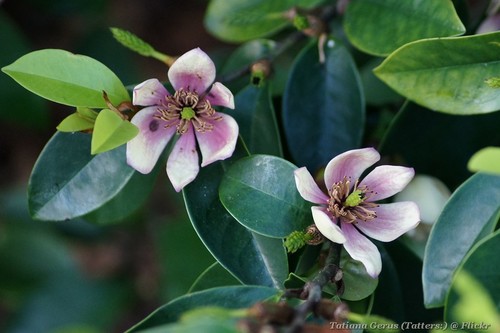
Sources differ on mature height, reporting about 250–500 cm, while mature spread is 150–500 cm; growth is slow to moderate, with young plants capable of moderate growth before growth slows as plants become taller. The alternate leaves are leathery, glossy, and dark green, ranging in shape from oblanceolate to narrowly elliptic or elliptic with pointed tips; young parts and petioles may bear brown hairs. Axillary flowers are cup-shaped to partly open, usually yellowish white, creamy yellow, or ivory, sometimes with purplish-red or dark-red margins; they have a strong sweet fragrance often described as resembling banana or ripe melon, and purple or burgundy cultivars also occur. Sources differ on flowering season, while the fruit is generally reported to be an aggregate of follicles that splits open at maturity to expose the seeds, with fruiting time varying between its native range and Japan.
Light
Magnolia figo grows in full sun to bright partial shade, with partial shade considered more suitable; in hot regions it should be protected from strong direct sunlight.
Watering
Keep the soil evenly and moderately moist with good drainage, avoiding prolonged dryness or waterlogging.
Temperature and dormancy
A single source reports a minimum temperature of about -5 °C; sources are few. A single source reports a hardiness range extending across several USDA zones, with better performance in the warmer part of that range.
Growing medium and mounting
Sources differ in their soil descriptions, but indicate fertile, organic- or humus-rich, well-drained loam or sandy loam that retains moderate moisture; several horticultural sources favor slightly acidic to neutral soil.
Feeding
Magnolia figo prefers fertile soil, and Chinese-language sources explicitly describe it as favoring fertile conditions.
Propagation
It can be propagated from seed, softwood cuttings, or semi-ripe cuttings, with seed sown when mature or in autumn.
Common problems
Possible pests include scale insects, magnolia scale, box-tree-weevil types, horse-chestnut scale, and capsid-bug types. Possible diseases include sooty mould, coral spot, Phytophthora-related disease, grey mould, Armillaria disease, viral disease, and fungal leaf spot. Waterlogging, overly dry soil, strong sunlight, or unsuitable low temperatures can cause growth problems; leaves may turn yellow-green in full sun, and late frost can damage flowers. It is relatively sensitive to frost and dry, cold, strong winds and is best grown in a sheltered position; late frost in cold regions can damage the flowers.
Identification
Magnolia figo can be recognized by its evergreen, glossy, leathery leaves, brown hairs often present on young branches, buds, and petioles, and pale axillary flowers with a very noticeable sweet, banana-like fragrance.
Photos


Sources
- Wikipedia (en): Magnolia figo — CC BY-SA 4.0 · link
- 維基百科:含笑花 — CC BY-SA 4.0 · link
- Wikipedia (ja): カラタネオガタマ — CC BY-SA 4.0 · link
- Wikipedia (de): Magnolia figo — CC BY-SA 4.0 · link
- Wikipedia (fr): Magnolia figo — CC BY-SA 4.0 · link
- NC State Plant Toolbox: Magnolia figo — copyright (facts only) · link
- Useful Tropical/Temperate Plants: Magnolia figo — CC BY-NC-SA 3.0 (facts only) · link
- RHS Plants: Magnolia figo — © RHS, facts only · link