
Flowering Magnolia (Magnolia liliiflora)
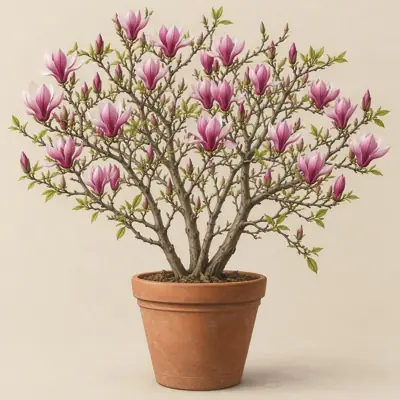
Magnolia liliiflora is a deciduous shrub to small tree, often with multiple stems and a spreading, relatively rounded form.
Overview
Magnolia liliiflora is a deciduous shrub to small tree, often with multiple stems and a spreading, relatively rounded form.
Origin and habitat
Magnolia liliiflora is native to China, mainly southern to south-central China; sources consistently include Sichuan and Yunnan, while records also include Fujian, Hubei, Hunan, and Shaanxi, and sources differ in their accounts of the range. Plants in Japan are from early introductions into cultivation rather than being native there. Its natural habitats are mainly slopes and forest edges. Its native climate can be subtropical and humid, and in cultivation it prefers warm, humid conditions.
Characteristics
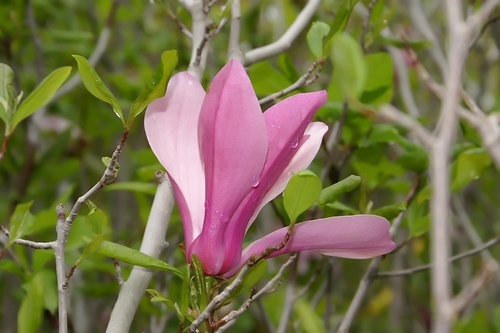
Sources differ on mature height, placing it at about 250–400 cm, while mature spread is 250–400 cm. Growth is slow; the leaves are alternate and simple, ranging from ovate and broadly ovate to obovate or ovate-elliptic, with dark green upper surfaces, gray-green undersides, possible hairs near the veins, and wedge-shaped bases. Sources differ in describing the large, upright, lightly fragrant flowers, which are borne singly at branch tips, range from bell- or cup-shaped to lily-like, and are mainly purple, purplish red to pinkish purple with paler or nearly white interiors. Sources differ on flowering details: flowering begins in early spring, usually before the leaves expand and potentially continues as they emerge, with some plants flowering sporadically again in summer; the fruit is reported to be a cylindrical aggregate of follicles, becoming dark purplish brown to brown when mature and revealing seeds with red fleshy outer coverings when the follicles split.
Light
It grows in full sun to partial sun and benefits from some shelter from unfavorable winds.
Watering
It prefers moist but well-drained soil and does not tolerate waterlogging or prolonged drought.
Temperature and dormancy
It can tolerate temperatures down to -20 °C. It is reported to have an RHS hardiness classification.
Growing medium and mounting
Sources differ on soil details, but fertile, organic-rich, loose, well-drained soil is preferred, with cultivation recommendations favoring acidic to neutral soil. Clay, loam, or sandy soil can be used, while calcareous or chalky soil is considered unsuitable.
Feeding
It is reported to be suitable for feeding in winter and after flowering, with additional feeding of young plants also recommended at another point in the growing cycle.
Propagation
It can be propagated by seed, layering, cuttings, division, grafting, or tissue culture, with softwood cuttings taken from late spring into summer. Seed is preferably sown after ripening, while stored seed requires cold treatment.
Common problems
Reported pests include scale insects, box weevil types, and longhorn beetles, while reported diseases include sooty mold, black spot, leaf blight, and leaf spot. The fleshy roots are readily injured during transplanting and have relatively poor wound healing, and the plant does not tolerate waterlogging or drought. Late frost may damage the flowers, and the relatively brittle branches favor a sheltered position. It can withstand low temperatures, although this tolerance may apply only to brief conditions.
Identification
Magnolia liliiflora has a smaller stature than most magnolias and bears large, upright, purplish-red flowers at branch tips in early spring, with petal-like flower parts often paler inside and flowering commonly beginning before the leaves expand.
Photos


Sources
- Wikipedia (en): Magnolia liliiflora — CC BY-SA 4.0 · link
- 維基百科:紫玉兰 — CC BY-SA 4.0 · link
- Wikipedia (ja): モクレン — CC BY-SA 4.0 · link
- Wikipedia (de): Purpur-Magnolie — CC BY-SA 4.0 · link
- Wikipedia (fr): Magnolia liliiflora — CC BY-SA 4.0 · link
- Wikipedia (es): Magnolia liliiflora — CC BY-SA 4.0 · link
- NC State Plant Toolbox: Magnolia liliiflora — copyright (facts only) · link
- Useful Tropical/Temperate Plants: Magnolia liliiflora — CC BY-NC-SA 3.0 (facts only) · link
- RHS Plants: Magnolia liliiflora — © RHS, facts only · link