
Powderpuff Cactus (Mammillaria bocasana)
Mammillaria bocasana is a small, clustering cactus with usually globose stems that readily produce offsets from the base and form dense mounds.
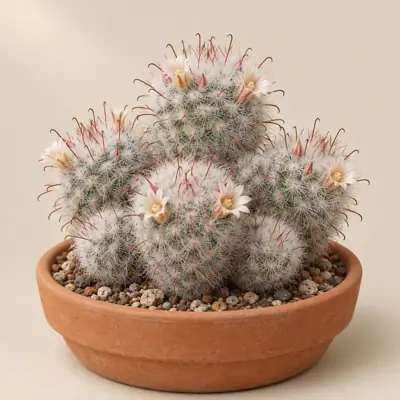
Overview
Mammillaria bocasana is a small, clustering cactus with usually globose stems that readily produce offsets from the base and form dense mounds.
Origin and habitat
Sources differ on its native range in north-central Mexico; records include San Luis Potosí, Zacatecas, and Querétaro, with Sierra de Bocas given as the type locality. Its natural habitat is a high-elevation, semi-desert environment in north-central Mexico. Sources differ in describing sites including canyon walls, volcanic rocks, foothills, locations beneath shrubs, and gentle limestone slopes.
Characteristics
Sources differ on mature height, giving about 5–10 cm, while a single source reports a mature spread of about 0–10 cm. It grows rapidly and readily produces basal offsets that form clusters. The funnel-shaped flowers range from creamy white and creamy yellow to pale pink and pink, and flowering occurs from spring through summer, with some horticultural sources describing the main flowering period as late spring through summer. The cylindrical fruit matures from rose-pink to red and contains reddish-brown seeds with a slightly lateral hilum.
Light
Mammillaria bocasana takes full sun and is suited to abundant sunlight or bright conditions; greenhouse plants may receive bright filtered light, while some shade can be provided in summer in hot regions.
Watering
Water moderately to regularly during the growing season while avoiding overwatering and maintaining good drainage, as persistently wet medium can cause root loss or rot; in winter, greatly reduce watering and keep the medium nearly dry.
Humidity and airflow
It prefers low humidity and is reported to need good airflow.
Temperature and dormancy
Sources differ on the minimum temperature, placing it at about -5 °C, while specialist-supported information gives a cold minimum of -5 °C. It tolerates brief light frost and rests cool and dry in winter. A single-source account also reports tolerance of brief light frost, while sources differ in their hardiness-zone descriptions.
Growing medium and mounting
Mammillaria bocasana needs a very fast-draining, porous cactus mix; loamy or sandy substrates can be supplemented with mineral materials such as coarse sand, pumice, or perlite to improve drainage, while an excessively high proportion of organic matter should be avoided.
Feeding
It can be fed during the growing season, but sources differ between recommending a fertilizer higher in potassium and phosphorus and lower in nitrogen and recommending a balanced liquid fertilizer applied regularly.
Propagation
Mammillaria bocasana can be propagated by seed, division, cuttings, or its readily formed offsets, with early-spring sowing also recommended.
Common problems
A single source reports that mealybugs may be a problem and generally reports no significant diseases. The main cultivation problems are root loss and rot from an overly wet medium or overwatering; excessive moisture and shade can also cause swollen, irregular growth. Cold tolerance is limited; some information indicates brief tolerance of subzero temperatures, but reported limits vary widely, and commercial cultivation information advises avoiding severe frost.
Identification
The stems are densely covered in long, fine, threadlike white hairy spines, giving them the appearance of white cotton balls; beneath the hairs are reddish-brown to brown central spines, usually with one and occasionally two hooked spines. Plant appearance, the amount of hair, and flower color vary markedly.
Photos


Sources
- Wikipedia (en): Mammillaria bocasana — CC BY-SA 4.0 · link
- Wikipedia (de): Mammillaria bocasana — CC BY-SA 4.0 · link
- Wikipedia (fr): Mammillaria bocasana — CC BY-SA 4.0 · link
- Wikipedia (es): Mammillaria bocasana — CC BY-SA 4.0 · link
- LLIFLE Encyclopedia of living forms: Mammillaria bocasana — CC BY-SA · link
- RHS Plants: Mammillaria bocasana — © RHS, facts only · link
- Desert-Tropicals: Mammillaria bocasana — © Philippe Faucon (desert-tropicals.com), facts only · link
- The Succulent Plant Page: Mammillaria (genus-level) — © R.J. Hodgkiss, facts only · link
- PUKUBOOK: Mammillaria bocasana — CC BY-NC (facts only) · link
- Mammillaria bocasana - Powder Puff Cactus - Mountain Crest Gardens (mountaincrestgardens.com) — facts only (§12) · link
- Mammillaria bocasana | Giromagi cactus and succulents for sale | Buy plants onli (www.giromagi.com) — facts only (§12) · link