
Gold Lace Cactus (Mammillaria elongata)
Mammillaria elongata is a clustering cactus with many cylindrical stems branching from the base; the stems range from upright to semi-prostrate and can eventually lie down to form dense clumps.
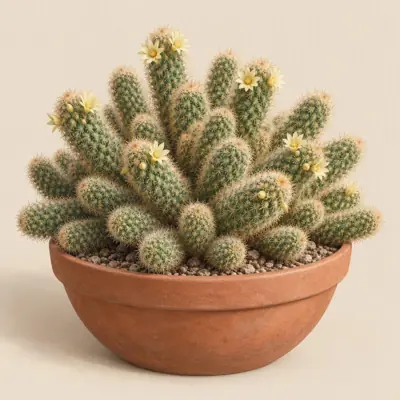
Overview
Mammillaria elongata is a clustering cactus with many cylindrical stems branching from the base; the stems range from upright to semi-prostrate and can eventually lie down to form dense clumps.
Origin and habitat
Sources differ on its native range: it is placed in central Mexico, with Hidalgo, Guanajuato and Querétaro specifically listed, while another account records a particular locality in San Luis Potosí. Its natural habitat is reported to include desert regions of Mexico. In cultivation it suits sunny conditions with relatively low humidity, while outdoor cultivation is considered more suitable in mild climates with moderate humidity.
Characteristics
Sources differ on mature height, placing it at about 15–20.32 cm, while the few evidence available reports a mature spread of about 30 cm. Sources describe the small flowers as commonly white, cream-yellow or pale yellow, sometimes with pink or red tones or a darker central stripe; they are borne on the upper part of the stems or between the tubercles. Flowering is mainly in spring, with some accounts extending the flowering period from late winter into early summer. The fruit is reported to range from cylindrical to spherical and to mature red or brown, containing many brown seeds; growth is generally reported to be vigorous and fast.
Light
Sources differ on light exposure: recommendations range from bright light or full sun to partial sun or light shade, with avoidance of intense afternoon exposure suggested in hot conditions. Mammillaria elongata takes full sun.
Watering
Water moderately during active growth, avoiding waterlogging and allowing the growing medium to dry thoroughly before watering again; in winter, watering should be greatly reduced or conditions kept nearly dry to reduce the risk of rot.
Humidity and airflow
Mammillaria elongata is reported to prefer low humidity.
Temperature and dormancy
Sources differ on the minimum temperature, with a value around -1 °C reported; a specialist-supported cold minimum is -1 °C. An ideal temperature range is reported, and specialist sources place it within a warm USDA hardiness range. It tolerates brief light frost. It rests cool and dry in winter.
Growing medium and mounting
Use a well-drained cactus growing medium; coarse sand, small gravel, pumice or perlite may be incorporated to improve drainage, and suitable soils are described as including loam and sandy soil across acidic, neutral and alkaline conditions. It needs a fast-draining mix.
Feeding
During active growth, a balanced liquid fertilizer may be applied regularly; another cultivation source recommends a single application of slow-release general fertilizer in spring.
Propagation
Mammillaria elongata can be propagated from seed, side shoots or by division, with early-spring sowing also described under warm conditions. Reported propagation methods include side shoots, seed and division.
Common problems
Mealybugs may affect Mammillaria elongata, while scale insects are additionally listed in information applying at the Mammillaria genus level. It is generally reported to have few disease problems. Poor drainage or overly frequent watering can cause rot; cultivation guidance emphasizes thorough drainage and allowing the medium to dry between waterings. It does not tolerate severe frost or prolonged cold and should be kept dry during cold periods; guidance for a red-spined cultivar additionally recommends avoiding intense sun exposure and rain.
Identification
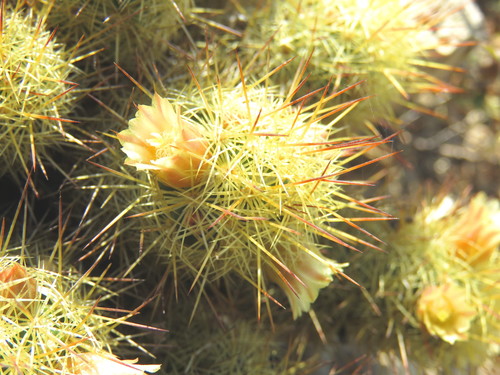
Mammillaria elongata has densely clustering, slender bright-green cylindrical stems with conical tubercles arranged spirally; each areole bears many short radial spines that interlace into a netlike or starburst covering, ranging from white and cream-yellow through golden yellow to brown, while central spines are few or absent.
Photos



Sources
- Wikipedia (en): Mammillaria elongata — CC BY-SA 4.0 · link
- Wikipedia (de): Mammillaria elongata — CC BY-SA 4.0 · link
- Wikipedia (fr): Mammillaria elongata — CC BY-SA 4.0 · link
- Wikipedia (es): Mammillaria elongata — CC BY-SA 4.0 · link
- LLIFLE Encyclopedia of living forms: Mammillaria elongata — CC BY-SA · link
- RHS Plants: Mammillaria elongata — © RHS, facts only · link
- Desert-Tropicals: Mammillaria elongata — © Philippe Faucon (desert-tropicals.com), facts only · link
- The Succulent Plant Page: Mammillaria (genus-level) — © R.J. Hodgkiss, facts only · link
- 臺北典藏植物園 植物資料庫: Mammillaria elongata — © 臺北典藏植物園, facts only · link
- NC State Plant Toolbox: Mammillaria (genus-level) — copyright (facts only) · link
- Mammillaria elongata - Ladyfinger Cactus | MCG™ (mountaincrestgardens.com) — facts only (§12) · link
- Mammillaria elongata | Giromagi cactus and succulents for sale | Buy plants onli (www.giromagi.com) — facts only (§12) · link
- PUKUBOOK: Mammillaria elongata — CC BY-NC (facts only) · link