
old woman cactus (Mammillaria hahniana)
Mammillaria hahniana is an evergreen, perennial cactus with a globose to short-columnar habit that can produce basal offsets and form clusters.
Overview
Mammillaria hahniana is an evergreen, perennial cactus with a globose to short-columnar habit that can produce basal offsets and form clusters.
Origin and habitat
Mammillaria hahniana is native to central Mexico; sources agree on Guanajuato, San Luis Potosí, and Querétaro, while differing on whether its range also includes Tamaulipas or extends south to Jalisco. It occurs in arid environments, including submontane scrub and deciduous forest on steeper slopes, and is native to arid to semiarid conditions with warm, dry conditions favored during the growing season.
Characteristics
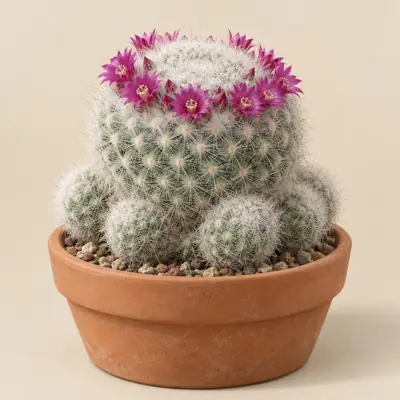
Sources differ on mature height, giving a range of about 9–20 cm, while mature spread is 10–50 cm. It is reported to grow relatively quickly compared with other Mammillaria and can form large clusters relatively rapidly. Flowers range from purplish red and purple to rose-red and pink and are often arranged in a ring near the top of the plant. Sources differ on flowering season: it flowers mainly from late winter through spring, with some accounts extending flowering into summer; the fruit is red to purple and club-shaped or small.
Light
It takes full sun or bright light, though sources differ in describing its light needs; afternoon shade can be suitable in hot conditions, while indoors it needs bright light and can receive some direct sun.
Watering
Water moderately to regularly during the growing season without overwatering, and keep it dry or nearly dry in winter in a well-drained medium.
Humidity and airflow
It is reported to prefer low humidity.
Temperature and dormancy
A cold minimum of -6 °C is supported, while sources differ on a separate minimum-temperature estimate of about -6 °C. It is frost hardy and rests cool and dry in winter. Hardiness classifications are reported in both the USDA and RHS systems.
Growing medium and mounting
It needs a fast-draining cactus mix, which may be loamy or sandy and may include coarse sand or gravelly material to improve drainage. Sources support acidic, neutral, and alkaline growing media.
Feeding
Feed during the growing season; recommendations include a high-potassium fertilizer in summer or a balanced liquid fertilizer applied regularly.
Propagation
Propagation can be by seed, offsets, or division, with sowing recommended in early spring.
Common problems
Mealybugs may occur, and genus-level information for Mammillaria also records scale insects. It is generally reported to have few disease problems, while overwatering is reported to cause rot. It can tolerate brief cold conditions, but cold tolerance is associated with staying dry, and cold, wet winter conditions should be avoided.
Identification
The plant body is pale green to gray-green and densely covered with white, long, slender, soft hair-like spines and white wool, with the white hairs becoming denser at maturity. It usually has numerous white radial spines and fewer, shorter central spines whose tips may sometimes be red.
Photos


Sources
- Wikipedia (en): Mammillaria hahniana — CC BY-SA 4.0 · link
- Wikipedia (de): Mammillaria hahniana — CC BY-SA 4.0 · link
- Wikipedia (fr): Mammillaria hahniana — CC BY-SA 4.0 · link
- Wikipedia (es): Mammillaria hahniana — CC BY-SA 4.0 · link
- LLIFLE Encyclopedia of living forms: Mammillaria hahniana — CC BY-SA · link
- Useful Tropical/Temperate Plants: Mammillaria hahniana — CC BY-NC-SA 3.0 (facts only) · link
- RHS Plants: Mammillaria hahniana — © RHS, facts only · link
- Desert-Tropicals: Mammillaria hahniana — © Philippe Faucon (desert-tropicals.com), facts only · link
- The Succulent Plant Page: Mammillaria (genus-level) — © R.J. Hodgkiss, facts only · link
- NC State Plant Toolbox: Mammillaria (genus-level) — copyright (facts only) · link
- Mammillaria hahniana | Giromagi cactus and succulents for sale | Buy plants onli (www.giromagi.com) — facts only (§12) · link
- PUKUBOOK: Mammillaria hahniana — CC BY-NC (facts only) · link