
Mammillaria spinosissima (Mammillaria spinosissima)
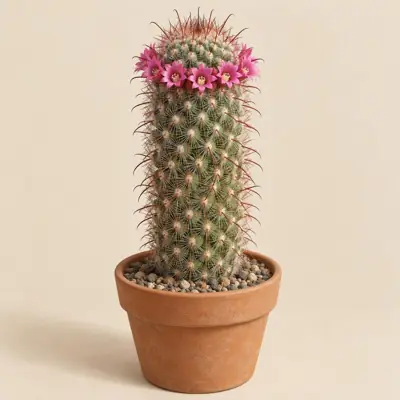
Mammillaria spinosissima is columnar and upright, initially often solitary but later able to branch from the base and form clumps.
Overview
Mammillaria spinosissima is columnar and upright, initially often solitary but later able to branch from the base and form clumps.
Origin and habitat
Sources differ on its native range in central Mexico: it is mainly reported from Guerrero and Morelos, while some accounts also include Mexico State. Sources differ on habitat details, describing mountainous tropical dry forest and xeric scrub. It occurs in relatively dry, low-humidity environments.
Characteristics
Sources differ, with limited evidence indicating a mature height of about 30–30 cm; mature spread is 6–10 cm. It is reported to grow rapidly and, under good conditions, to branch from the base and develop into a larger clump over several years. Funnel-shaped flowers open in a ring near the stem tip and are mainly deep pink, purplish pink, or carmine pink; flowering occurs in spring. Sources differ in describing the small, club-shaped, smooth, juicy fruit as green, dark purple, reddish brown, or reddish purple, with brownish seeds inside.
Light
Sources differ on light conditions, describing bright, strong light to full sun; indoors, bright light with some direct sunlight is suitable, while hot conditions may call for some shade or filtered light and sudden exposure should be avoided to prevent scorching. Mammillaria spinosissima takes full sun.
Watering
Water moderately during the growing period without keeping the plant persistently wet or waterlogged; in winter, keep it nearly dry with good ventilation.
Humidity and airflow
Mammillaria spinosissima prefers low humidity and is reported to need good airflow.
Temperature and dormancy
Sources differ, with limited evidence suggesting a minimum of about -3–-3 °C. Its hardiness is described using USDA and RHS classifications, and it tolerates brief light frost. It rests cool and dry in winter, with a cold minimum of 5 °C. It is reported to be frost hardy.
Growing medium and mounting
Sources differ on mix details, but describe a well-drained, porous cactus medium that may contain sandy or loamy material with reduced organic matter; prolonged waterlogging should be avoided. It is reported to need a very fast-draining mix.
Feeding
A balanced liquid fertilizer is reported to be applied regularly during the growing period.
Propagation
Mammillaria spinosissima can be propagated by seed or by separating basal offsets; seed can be sown in early spring, and offsets can also be used as cuttings. Seed is a propagation method.
Common problems
Mealybugs may affect Mammillaria spinosissima, and scale insects are also recorded as a problem for Mammillaria. Diseases are generally uncommon. Prolonged wetness in the growing medium is reported to cause root damage or rot, so overwatering should be avoided. It prefers low humidity, and scorching should be avoided when growing it in strong light.
Identification
Mammillaria spinosissima has blue-green to deep blue-green columnar stems densely covered with fine spines; spine color varies widely and may be white, yellow, red, or reddish brown, while the flowers commonly form a ring near the stem tip.
Photos


Sources
- Wikipedia (en): Mammillaria spinosissima — CC BY-SA 4.0 · link
- Wikipedia (de): Mammillaria spinosissima — CC BY-SA 4.0 · link
- Wikipedia (fr): Mammillaria spinosissima — CC BY-SA 4.0 · link
- Wikipedia (es): Mammillaria spinosissima — CC BY-SA 4.0 · link
- LLIFLE Encyclopedia of living forms: Mammillaria spinosissima — CC BY-SA · link
- RHS Plants: Mammillaria spinosissima — © RHS, facts only · link
- Desert-Tropicals: Mammillaria spinosissima — © Philippe Faucon (desert-tropicals.com), facts only · link
- NC State Plant Toolbox: Mammillaria (genus-level) — copyright (facts only) · link
- Mammillaria spinosissima | Giromagi cactus and succulents for sale | Buy plants (www.giromagi.com) — facts only (§12) · link
- PUKUBOOK: Mammillaria spinosissima — CC BY-NC (facts only) · link