
mangoso (Mangifera indica)
Mangifera indica is a large evergreen fruit tree; intensively cultivated plants maintained by grafting and pruning can be kept shorter. It is a perennial, evergreen, long-lived woody plant.
Overview
Mangifera indica is a large evergreen fruit tree; intensively cultivated plants maintained by grafting and pruning can be kept shorter. It is a perennial, evergreen, long-lived woody plant.
Origin and habitat
Sources differ on its native range, placing it broadly from South Asia to Southeast Asia, with the core range including the Indian subcontinent, Bangladesh, Myanmar, and areas around the Indochinese Peninsula. It can grow in more open or secondary environments within humid tropical forests; sources usually place it at lower elevations, although it can also grow at higher elevations. It is suited to tropical through frost-free subtropical climates, and a distinct dry season or cooler period can help induce flowering.
Characteristics
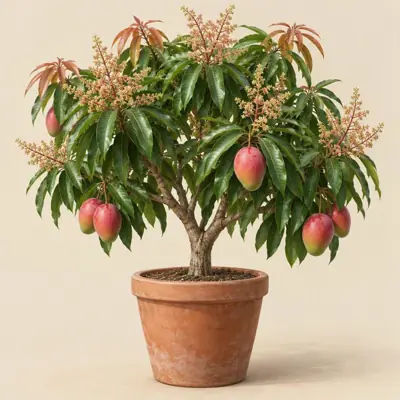
Sources differ on mature height, with the few available sources giving about 200–300 cm; a single source reports a mature spread of about 2000–3000 cm. Growth is moderate, although some sources also describe it as fast; the leaves are reported to be simple and evergreen, leathery to somewhat firm with a waxy sheen, with mature leaves dark green and mainly oblong to lance-shaped, while young leaves may be red, salmon-red, or orange-pink before becoming dark green. Sources differ in their descriptions of the flowers, which are mainly borne in large terminal panicles and are small, often yellowish white, pale yellow, or pink; both male and bisexual flowers occur on the same plant, and flowering is reported to usually occur from late winter to early spring, although timing varies markedly with region and climate. The fruit is a fleshy drupe that may be round, ovate, or kidney-shaped, with a large flattened stone in the center; unripe fruit is generally green and may become yellow, orange, or red when ripe, while sources for 'Irwin' specifically describe large fruit with red skin at maturity and orange, intensely sweet flesh.
Light
It is reported to prefer full sun, while indoor cultivation requires bright light.
Watering
Water moderately after the surface soil dries; the plant has some drought tolerance, and a drier season can help promote flowering.
Temperature and dormancy
Sources differ on the minimum temperature, with few sources indicating about -1 °C, and sources also differ on the ideal range, placing it at about 24–30 °C. A single source reports a maximum of about 48 °C. It is generally placed in USDA zones appropriate to tropical or near-tropical cultivation, with the cooler listed zone requiring winter protection. It is reported to tolerate brief light frost.
Growing medium and mounting
It prefers well-drained soil; sources also describe humus-rich sandy soil as suitable and indicate that it can adapt to various soil types.
Propagation
A single source reports that seeds germinate readily in fertile, well-irrigated soil and that grafting is also used in intensive cultivation.
Common problems
It is sensitive to frost, and tender new growth can be severely damaged around the freezing point; rain during flowering may reduce pollination or fruit set. A single source reports that cool conditions can slow or stop growth, while heavy rain during flowering may interfere with pollination and fruit set.
Identification
It is generally identified by evergreen, leathery dark-green leaves, large terminal flower clusters, and large drupes; a single source distinguishes 'Irwin' by its large fruit, red skin at maturity, and orange flesh.
Photos


Sources
- Wikipedia (en): Mangifera indica — CC BY-SA 4.0 · link
- 維基百科:芒果树 — CC BY-SA 4.0 · link
- Wikipedia (ja): マンギフェラ・インディカ — CC BY-SA 4.0 · link
- Wikipedia (de): Mango — CC BY-SA 4.0 · link
- Wikipedia (fr): Manguier — CC BY-SA 4.0 · link
- Wikipedia (es): Mangifera indica — CC BY-SA 4.0 · link
- GBIF descriptions: The checklist of alien seed plants of D.R. Congo, based on evidence from herbarium collections; Arbo — per dataset · link
- Wikipedia (nl): Mango (soort) — CC BY-SA 4.0 · link
- Wikipedia (pt): Mangifera indica — CC BY-SA 4.0 · link
- Useful Tropical/Temperate Plants: Mangifera indica — CC BY-NC-SA 3.0 (facts only) · link
- USDA PLANTS Database: Mangifera indica — Public domain (US Government work) · link
- Top Tropicals catalog: Mangifera indica — © Top Tropicals LLC (facts only) · link