
prayerplant (Maranta leuconeura)
Maranta leuconeura is an evergreen, rhizomatous, clump-forming herbaceous perennial with a horizontally creeping growth habit.
Overview
Maranta leuconeura is an evergreen, rhizomatous, clump-forming herbaceous perennial with a horizontally creeping growth habit.
Origin and habitat
Maranta leuconeura is native to Brazil, with more detailed sources placing it in the Atlantic forests of eastern Brazil and in central Brazil. It is reported to inhabit the understory of tropical and Atlantic forests in Brazil, where it can spread horizontally across the forest floor and root at the nodes. Its native environment is tropical, humid, and shaded.
Characteristics
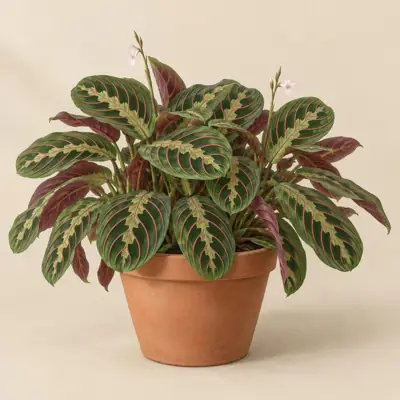
Sources differ, but limited evidence places mature height at about 0–30 cm and mature spread at about 0–30 cm. The leaves are ovate to elliptic, with entire margins and conspicuous patterns; red-veined forms have dark green upper surfaces, a paler central area, and prominent red fishbone-like veins, while the undersides may be dark red, purple-green, or gray-green. The leaves lie flatter by day and rise or fold upward at night; the small tubular flowers range from white to pale pink, pale purple, or purple and are less common indoors and generally less ornamental than the foliage. Flowering occurs during the growing season, with RHS specifically noting that flowering may occur in summer.
Light
Provide bright filtered or indirect light through partial shade or shade, and avoid strong direct sunlight.
Watering
During the growing season, keep the growing medium evenly moist but well drained and avoid waterlogging; reduce watering in winter and allow the soil to become somewhat drier.
Humidity and airflow
Maranta leuconeura prefers high humidity.
Temperature and dormancy
Limited single-source information reports an ideal temperature range of about 16–27 °C, with about 15 °C as the minimum and about 27 °C as the maximum. It is generally reported as frost tender; keep above freezing. It is also generally reported for USDA hardiness zones described by the source.
Growing medium and mounting
Sources differ on suitable soils, but describe a well-drained, humus-rich medium and adaptation to clay and loam; RHS also lists chalk and sand and considers acidic, neutral, and alkaline conditions suitable.
Feeding
Feed regularly during the growing season, reduce feeding in winter or during the rest of the year, and avoid overfeeding because it may scorch the leaves.
Propagation
Maranta leuconeura can be propagated by division, cuttings, or seed, with rhizome division particularly suitable for established clumps.
Common problems
Greenhouse red spider mites and mealybugs are reported as possible pests. RHS considers disease generally uncommon, while literature sources record sugarcane mosaic virus in plants in Costa Rica and the fungus Bipolaris marantae in nurseries in Brazil. Persistently dry conditions or dry air can damage and dry the leaves, while overly strong sunlight may damage or bleach the foliage; waterlogging, low humidity, cold drafts, high fluoride, and overfeeding may also cause problems. It is sensitive to frost and low temperatures and should be protected from freezing; cultivation sources also advise keeping it above a minimum temperature.
Identification
Red-veined forms are distinguished by dark green upper leaf surfaces, a paler central marking, and conspicuous red fishbone-like veins; the leaves lie flat by day and rise upward at night.
Photos


Sources
- GBIF Backbone: Maranta leuconeura É.Morren — CC BY 4.0 · link
- Wikipedia (en): Maranta leuconeura — CC BY-SA 4.0 · link
- 維基百科:豹紋竹芋 — CC BY-SA 4.0 · link
- Wikipedia (de): Maranta leuconeura — CC BY-SA 4.0 · link
- Wikipedia (fr): Maranta leuconeura — CC BY-SA 4.0 · link
- NC State Plant Toolbox: Maranta leuconeura — copyright (facts only) · link
- Wikipedia (it): Maranta leuconeura — CC BY-SA 4.0 · link
- TaiCOL 臺灣物種名錄: Maranta leuconeura — CC BY 4.0 · link
- RHS Plants: Maranta leuconeura — © RHS, facts only · link
- Top Tropicals catalog: Maranta leuconeura — © Top Tropicals LLC (facts only) · link