
Masdevallia hybrid (Masdevallia hybrid)
Masdevallia is reported to comprise small, perennial orchids with an upright to creeping-rhizome habit that may be epiphytic, terrestrial, or lithophytic.
Overview
Masdevallia is reported to comprise small, perennial orchids with an upright to creeping-rhizome habit that may be epiphytic, terrestrial, or lithophytic.
Origin and habitat
Sources differ on its range, describing Masdevallia as occurring from Mexico through Central America into South America, reaching southern Brazil and being concentrated mainly in the Andes of South America. It is generally reported to occur mainly in cool, moist, cloudy mountain habitats and cloud forests at high elevations, growing epiphytically, terrestrially, or on moist rocks. Most species are generally adapted to cool, highly humid conditions at high elevations and do not tolerate dryness or high temperatures well.
Characteristics
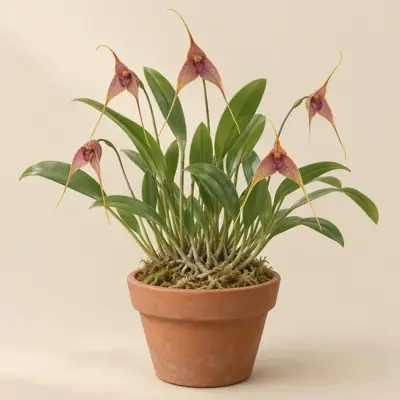
Sources differ on mature height, giving a range of about 10–30.48 cm. Masdevallia is reported to lack pseudobulbs, with stems usually bearing a single slightly fleshy, ovate to lanceolate leaf that may be upright or pendent. Flowers are reported to be mostly triangular and varied in color and pattern, with sepals fused at the base and often extended into tails; flowers may be solitary or borne in racemes, with colors including white, red, pink, orange, yellow, purple, brown, and multicolored forms. Flowering is reported not to have a fixed season, and flowers may appear intermittently through the year.
Light
Masdevallia generally favors bright, indirect light to partial shade; most species can accept some direct sunlight, but overly intense sunlight should be avoided. The few available source data suggest about 10750–21500 for light levels. It is generally categorized as requiring low light.
Watering
The medium should generally remain moist without prolonged waterlogging and should not dry out completely during active growth; most species are sensitive to dissolved salts, so rainwater, distilled water, or another low-salt water source is preferred. In general, keep evenly moist.
Humidity and airflow
The limited source evidence suggests humidity of about 60–90 %. Masdevallia generally prefers high humidity.
Temperature and dormancy
Masdevallia is generally cool-growing and is reported to favor cool conditions while being sensitive to excessive heat. It is reported to be frost tender; keep above freezing.
Growing medium and mounting
A growing medium may generally include sphagnum moss, fine orchid bark, tree-fern fiber, sand, or mixtures of these, with both moisture retention and drainage; the rhizome should remain at the medium surface to reduce rot risk. Masdevallia is reported as epiphytic and having fine terrestrial roots. A bark and sphagnum mix is generally preferred.
Feeding
Sources differ on feeding: fertilizer should be used at low concentration, with one source recommending regular balanced fertilizer during growth and another recommending very dilute liquid fertilizer during particular parts of the year while avoiding the hottest period.
Propagation
Masdevallia is reported to be propagated by division, with sufficiently large plants recommended for division and each resulting division retaining a substantial number of leaves.
Common problems
Reported pests include aphids, spider mites, and mealybugs. Specific diseases are generally reported to be uncommon, while good airflow in humid conditions can help reduce damage from fungal leaf spots. Dryness, insufficient humidity, or high temperatures may cause leaf loss or even plant collapse; excessive dissolved salts in irrigation water may cause blackened leaf tips, yellowing, and gradual dieback, while burying the rhizome too deeply carries a risk of rot. Masdevallia is generally sensitive to hot, dry conditions and low air humidity, especially high-elevation cool-growing species, which tolerate heat poorly.
Identification
Masdevallia is reported to lack pseudobulbs and usually has a single leaf per stem; its flowers are often triangular, with sepals fused at the base and frequently bearing conspicuous tail-like extensions.