
Balm (Melissa officinalis)
Melissa officinalis is a perennial herb with an upright, clumping, much-branched habit, four-angled stems, and rhizomes.
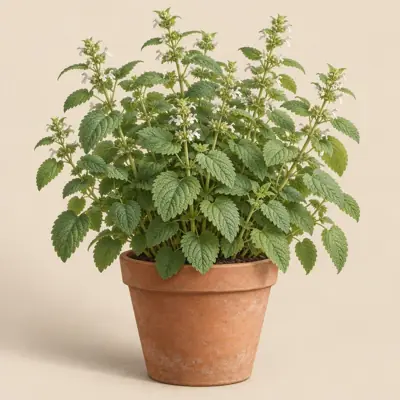
Overview
Melissa officinalis is a perennial herb with an upright, clumping, much-branched habit, four-angled stems, and rhizomes.
Origin and habitat
Sources differ on its native range: it is mainly native from southern Europe through the Mediterranean region and into western and central Asia, while some accounts also include northwestern Africa; it is now widely cultivated beyond its native range and naturalized in many areas. It occurs in habitats including roadsides, waste ground, disturbed areas near homes, grasslands, riverbanks, hedges, woodland edges, and woodland clearings, and is often associated with moister, organic-rich or fertile, well-drained soils. It is reported to suit temperate environments and tolerate cold, and has been cultivated or naturalized in many temperate regions worldwide.
Characteristics
Sources differ on mature height, placing it at about 50–100 cm, while a single source reports a mature spread of about 10–50 cm. The opposite, stalked leaves are generally ovate to heart-shaped and green, with hairy or rough, wrinkled surfaces, prominent veins, and rounded-toothed or coarsely toothed margins; they release a distinct lemon scent when crushed or bruised. Sources differ in describing the small, two-lipped flowers, which occur in clusters in the upper leaf axils and are mainly white or creamy white but may have pale pink, pale purple, or pale yellow tones; they are rich in nectar and attract bees and other pollinating insects, with flowering from early summer through summer. A single source reports that the mature fruit divides into small, smooth, nutlet-like segments that may become brown to nearly black.
Light
Melissa officinalis grows in full sun to partial shade; some sources also indicate that it can grow in shadier positions and benefits from shade under hot or intense direct sunlight.
Watering
Sources differ on watering characteristics: it prefers moist but well-drained soil and should not remain waterlogged for long periods, while some sources indicate that established plants have some drought tolerance.
Temperature and dormancy
A single source reports a minimum temperature of about -30 °C, although sources are few. Sources differ on hardiness classifications, while Melissa officinalis is frost hardy.
Growing medium and mounting
Melissa officinalis adapts to various soils, including clay, loam, sand, and calcareous soil, while preferring fertile, organic-rich, slightly moist but well-drained soil; soil conditions may range from acidic to alkaline.
Feeding
A single source reports that fertilizer may be applied in cultivation, that nutrient deficiency should be avoided during growth, and that feeding after harvest can encourage regrowth; the same source also mentions slow-release compound fertilizer as a base fertilizer.
Propagation
Melissa officinalis can be propagated from seed, cuttings, or division, with division carried out in spring or autumn; propagation from seed is also easy, and the plant can self-seed.
Common problems
Leafhoppers may cause damage, and spider mites may also occur in hot, dry conditions; diseases are generally uncommon, though verticillium wilt may occasionally occur. Strong self-seeding and rhizome spread can allow the plant to spread rapidly in gardens, while after flowering the leaves may become smaller, tougher, and less fragrant. Sources differ on weather sensitivities: intense direct sunlight may cause leaf scorch, excessive winter moisture should be avoided, and the plant is highly cold tolerant, with above-ground growth able to die back in cold areas and then regrow.
Identification
A key identifying feature is the lemon scent released when the leaves are crushed, together with four-angled stems, opposite leaves, and two-lipped flowers; the plant typically has an upright, much-branched, clumping appearance.
Photos


Sources
- Wikipedia (en): Lemon balm — CC BY-SA 4.0 · link
- 維基百科:香蜂花 — CC BY-SA 4.0 · link
- Wikipedia (ja): レモンバーム — CC BY-SA 4.0 · link
- Wikipedia (de): Zitronenmelisse — CC BY-SA 4.0 · link
- Wikipedia (fr): Mélisse officinale — CC BY-SA 4.0 · link
- Wikipedia (es): Melissa officinalis — CC BY-SA 4.0 · link
- GBIF descriptions: Manual of the Alien Plants of Belgium; Database of Vascular Plants of Canada (VASCAN); Checklist of — per dataset · link
- NC State Plant Toolbox: Melissa officinalis — copyright (facts only) · link
- Wikipedia (nl): Citroenmelisse — CC BY-SA 4.0 · link
- Useful Tropical/Temperate Plants: Melissa officinalis — CC BY-NC-SA 3.0 (facts only) · link
- RHS Plants: Melissa officinalis — © RHS, facts only · link
- USDA PLANTS Database: Melissa officinalis — Public domain (US Government work) · link
- Top Tropicals catalog: Melissa officinalis — © Top Tropicals LLC (facts only) · link