
Microsorum diversifolium (Microsorum diversifolium)
Microsorum diversifolium is an evergreen, perennial, rhizomatous fern that may creep, climb, or form low clumps and may grow as an epiphyte, terrestrially, or on rock. It is reported to be perennial.
Overview
Microsorum diversifolium is an evergreen, perennial, rhizomatous fern that may creep, climb, or form low clumps and may grow as an epiphyte, terrestrially, or on rock. It is reported to be perennial.
Origin and habitat
It is native from eastern to southeastern Australia and New Zealand, including southeastern Queensland, New South Wales, Victoria, Tasmania, Norfolk Island, and both main islands of New Zealand; sources also record the Chatham Islands, Kermadec Islands, and Antipodes Islands, while Wikipedia additionally lists Lord Howe Island. It may grow as an epiphyte, terrestrially, or on rock in forests, moist sclerophyll forests, rainforests, shrublands, open areas, rocky places, cliffs, and stream valleys, and in forests it can occur from the ground to the canopy. Sources describe it as growing in subtropical climates and also occurring in more open subalpine environments in the wild.
Characteristics
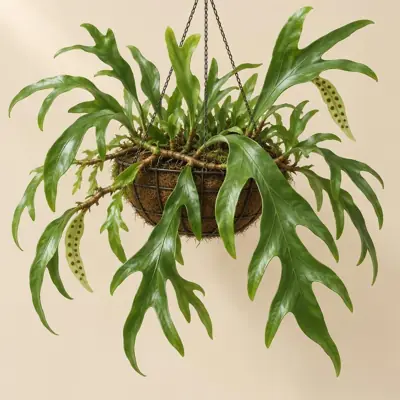
Mature plants reach 15.24–30.48 cm in height and 91.44–121.92 cm in spread. Growth is generally reported to be moderate. The green fronds are thick, leathery, glossy, and narrow, with margins that may be entire, wavy, or lobed, and they may range from upright to drooping; sources differ in their descriptions of frond size. It has a creeping rhizome, does not flower or form fruit, and reproduces by pale, warty spores.
Light
It tolerates shade and can grow in partial to full shade; indoors, bright indirect light can be provided.
Watering
It is generally reported to prefer moist but well-drained medium, with watering as the surface begins to dry while avoiding overwatering and prolonged standing water; it can also tolerate occasional dryness. It is generally reported to be kept slightly dry.
Humidity and airflow
The few available sources indicate humidity of about 50 %.
Temperature and dormancy
A source reports a USDA hardiness-zone classification for the species.
Growing medium and mounting
It is generally reported to prefer a moist, well-drained potting medium with an acidic to neutral pH and to tolerate occasional drying of the medium.
Feeding
A source reports using diluted balanced liquid fertilizer regularly in spring and summer.
Propagation
It is reported to be propagated from rhizome cuttings or spores. The pale, warty spores occur on the undersides of the fronds, and the plant reproduces by spores.
Common problems
Mealybugs, spider mites, and scale insects are reported as possible pests. Overwatering, poor drainage, or standing water may lead to root rot and other fungal problems, while insufficient water or low air humidity may cause brown frond tips.
Identification
Microsorum diversifolium has a long, creeping rhizome and thick, glossy fronds that are often lobed; mature fronds are often described as resembling a kangaroo foot, and conspicuous, nearly round, large sori occur on the undersides of the fronds.
Photos

