
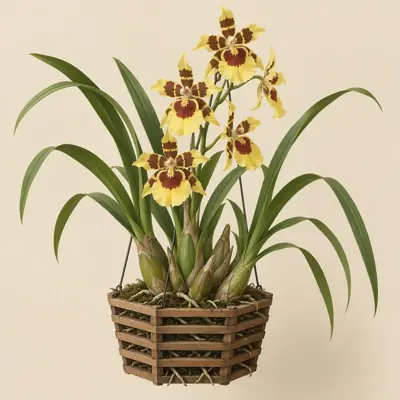
pansy orchid (Miltonia hybrid)
Miltonia is reported to be an epiphytic orchid with rhizomes and pseudobulbs, growing in relatively loose clumps.
Overview
Miltonia is reported to be an epiphytic orchid with rhizomes and pseudobulbs, growing in relatively loose clumps.
Origin and habitat
Miltonia is reported to be primarily native to Brazil, extending northward along mountainous areas including the Serra do Mar to Pernambuco; only M. flavescens is reported beyond Brazil, reaching northeastern Argentina and eastern Paraguay. It is generally epiphytic in forests, ranging from shaded to brighter sites but not full sun, and commonly occurs in airy locations with ample humidity at night and in the morning. Temperature preferences are reported to vary among species, while the genus can generally be grown under intermediate temperature conditions with a marked difference between day and night temperatures; its native environments have high humidity and good airflow.
Characteristics
Few sources report a mature height of about 50–50 cm. Growth is reported to be rapid, with pseudobulbs producing new growth points and quickly forming large colonies. Pseudobulbs generally bear leaves at their tips; the leaves are narrow, elongated, flexible, blunt to slightly pointed at the tip, and may range with the pseudobulbs from bright yellow-green to olive green. The waxy, spurless flowers may be white, pink, deep purple, pale yellow, pale purple, or spotted over a greenish-brown ground, with a usually broad, conspicuous lip; they are reported to have a delicate fragrance sometimes described as rose-like, and flowering time varies within the genus, with most species flowering from late spring through late summer and Miltonia cuneata beginning as early as late winter.
Light
Miltonia is reported to need bright conditions without full sun, with enough light to encourage flowering while avoiding excessive exposure; its native settings range from forest shade to brighter locations. Specialist guidance generally describes its requirement as medium light.
Watering
Water is reported to be needed throughout the year, with greater demand during active growth and flowering and without completely stopping watering during the rest period after flowering. Specialist guidance generally recommends keeping Miltonia slightly dry.
Humidity and airflow
Few sources report a humidity range of about 65–100 %.
Temperature and dormancy
Miltonia is reported to have a preferred temperature range, though the available claim does not establish an exact numerical range. Specialist guidance generally describes Miltonia as warm-growing.
Growing medium and mounting
Miltonia is reported to be epiphytic. Specialist guidance generally describes it as suitable for growing mounted.
Common problems
The thin leaves are reported to develop spots readily, commonly associated with fungal growth. Leaves may also become yellowish under the light levels used to support flowering, so light intensity is reported to require a balance between encouraging flowers and avoiding excessive yellowing. Miltonia is reported to require good airflow and high humidity and should not be exposed to full sun; temperature preferences vary among species, with a marked day-to-night temperature difference considered suitable.
Identification
Miltonia is reported to have somewhat spaced pseudobulbs bearing leaves at their tips, spurless flowers with a large and often spreading lip, and a footless column with hard pollinia. Compared with Miltoniopsis, which is often referred to as the pansy orchid, Miltonia flowers generally have a less pansy-like appearance.