
balsampear (Momordica charantia)
Momordica charantia is a herbaceous climbing vine with tendrils. It is usually grown as an annual in temperate regions but can be perennial in the tropics.
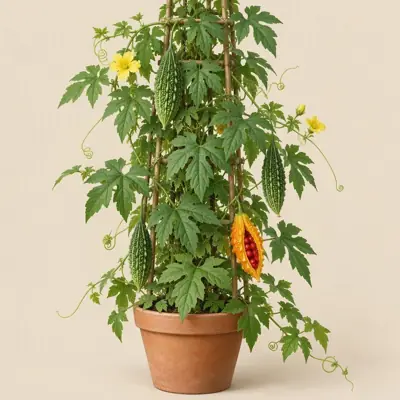
Overview
Momordica charantia is a herbaceous climbing vine with tendrils. It is usually grown as an annual in temperate regions but can be perennial in the tropics.
Origin and habitat
It is native to tropical regions of the Old World, mainly involving Africa and Asia, although sources differ on its exact area of origin. It is reported from savannas, scrub, coastal scrub, areas near streams, and lowland forest edges. It is adapted to hot tropical and subtropical environments and can also be cultivated in temperate regions with a sufficiently long growing season; it prefers hot, relatively humid climates.
Characteristics
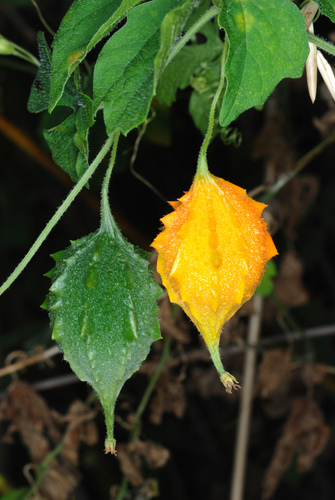
Momordica charantia reaches 400–500 cm and grows rapidly and vigorously, producing long vines within a growing season. Sources differ in descriptions of the leaves; they are simple and alternate, with deeply palmately lobed blades. The plant is monoecious, with separate yellow male and female flowers that are usually borne in the leaf axils. The fruit is oblong to slender and spindle-shaped with conspicuous wart-like projections; it is green when immature, turns yellow to orange as it matures, then softens and splits to reveal multiple flat seeds surrounded by bright red arils.
Light
It grows in full sun to partial sun and performs better with abundant sunlight.
Watering
Keep the soil moderately moist without waterlogging and use well-drained soil; mulch can help retain soil moisture.
Temperature and dormancy
A single source reports a minimum of about 3 °C, so sources are few. Sources differ on the ideal temperature, giving an approximate range of 22–30 °C. A single source reports a maximum of about 38 °C, so sources are few. It is generally reported for USDA hardiness zones in a warm range.
Growing medium and mounting
It prefers fertile, organic-rich, well-drained soil, with a mildly acidic preferred pH while tolerating a broader pH range.
Feeding
Cultivation guidance generally recommends fertilizer weighted toward nitrogen while avoiding boron deficiency; supplying micronutrients is reported to support growth and fruiting.
Propagation
It is generally propagated by seed; one cultivation approach starts seedlings indoors before the last spring frost and transplants them outdoors when temperatures are suitable.
Common problems
It may be affected by insect pests common to cucurbit crops. Boron deficiency can be a cultivation problem, while poor drainage and excessively wet soil do not suit its cultivation requirements. It is frost-sensitive and usually dies with the first frost in temperate regions, preferring warm to hot conditions.
Identification
Momordica charantia is a tendril-bearing vine distinguished by fruit densely covered with wart-like projections and having a bitter taste; mature fruit turns yellow to orange and splits open, exposing seeds with red arils.
Photos


Sources
- Wikipedia (en): Momordica charantia — CC BY-SA 4.0 · link
- 維基百科:苦瓜 — CC BY-SA 4.0 · link
- Wikipedia (ja): ツルレイシ — CC BY-SA 4.0 · link
- Wikipedia (de): Bittermelone — CC BY-SA 4.0 · link
- Wikipedia (fr): Momordica charantia — CC BY-SA 4.0 · link
- Wikipedia (es): Momordica charantia — CC BY-SA 4.0 · link
- GBIF descriptions: Listado de especies de plantas útiles comercializadas en los mercados del distrito de Barranquilla, — per dataset · link
- NC State Plant Toolbox: Momordica charantia — copyright (facts only) · link
- Useful Tropical/Temperate Plants: Momordica charantia — CC BY-NC-SA 3.0 (facts only) · link
- USDA PLANTS Database: Momordica charantia — Public domain (US Government work) · link