
Swiss Cheese plant (Monstera deliciosa)
Monstera deliciosa is a perennial evergreen climbing herb or vine that can climb by aerial roots and is also described as a hemiepiphyte.
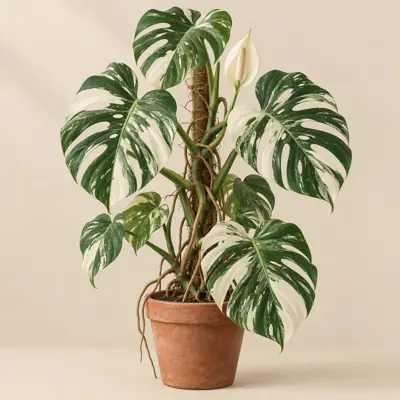
Watch: Monstera vs Philodendron vs Alocasia vs Anthurium
Overview
Monstera deliciosa is a perennial evergreen climbing herb or vine that can climb by aerial roots and is also described as a hemiepiphyte.
Origin and habitat
Sources differ on its native range, describing it as native from Mexico through Central America, with Mexico and Guatemala consistently included and broader accounts extending south to Panama. It grows as a climber in humid tropical forests, starting from the ground and ascending trees with aerial roots; some accounts also place it in humid montane forests. It is associated with warm, humid tropical to subtropical conditions and relatively high atmospheric humidity, and it does not tolerate low temperatures or frost well.
Characteristics
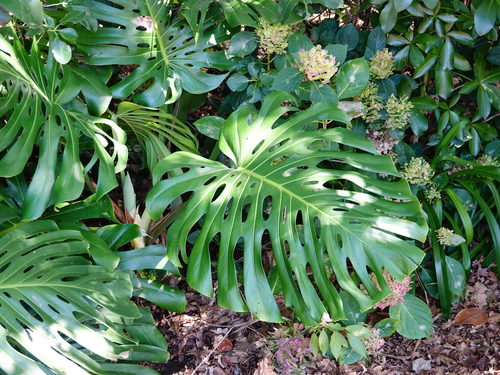
Sources differ, with limited evidence suggesting a mature height of about 400–800 cm; a limited source reports a mature spread of about 150–250 cm. Sources differ on its growth rate; its large, thick, leathery leaves are generally entire and heart-shaped to ovate when young, then progressively develop perforations and deep splits as they mature. The inflorescence has a typical aroid spadix with a large spathe; at flowering, the spathe is white to yellowish-white or creamy white, while the spadix is pale yellow to yellowish-white, and flowering is described from spring through autumn with flowering more likely during warmer periods.
Light
Sources differ in describing suitable light as bright indirect light to partial sun; it tolerates shade, but prolonged low light may cause elongated internodes and weak growth. Variegated cultivars need more light than dark-green cultivars, and transitions to strong light should be gradual.
Watering
Water thoroughly, then wait until the surface of the growing medium dries before watering again, avoiding prolonged waterlogging; maintain moderate moisture during active growth and keep conditions somewhat drier in winter.
Humidity and airflow
Monstera deliciosa prefers high humidity and is generally reported to need moderate airflow.
Temperature and dormancy
The ideal temperature range is 20–30 °C. Sources differ, with limited evidence suggesting a minimum of about 10 °C, while a limited source reports a maximum of about 38 °C. It is generally reported for USDA hardiness zones and is generally reported to tolerate brief light frost.
Growing medium and mounting
Use a well-drained, fertile, organic-rich loamy medium; loam-based potting media can be used, and adaptation to acidic, neutral, and alkaline soils has been recorded. It is generally reported to have aerial and soil roots and to favor an airy mix.
Feeding
Sources differ on feeding schedules, but describe regular fertilizing during the growing season using balanced liquid, slow-release, or long-lasting complete fertilizers.
Propagation
It can be propagated by stem cuttings, layering, or air layering; stem sections with nodes can root, and some sources also record division.
Common problems
Recorded pests include scale insects and spider mites, with fern scale also reported. Damping-off and similar diseases are reported, with risk increasing under excessively wet conditions in spring and autumn. Indoor winter conditions may cause new leaves to be fewer or to lack their typical perforations and deep splits; because the plant becomes large and climbs, sturdy support is needed to reduce the risk of stem breakage. It has poor cold tolerance: sufficiently low temperatures may stop growth, and frost can cause severe injury or death, although some mature plants have been recorded surviving brief light frost.
Identification
Monstera deliciosa is distinguished by the large perforations and deep splits of mature leaves and by long aerial roots produced at stem nodes; leaves progressively change from entire juvenile forms to perforated and deeply split mature forms.
Photos


Sources
- Wikipedia (en): Monstera deliciosa — CC BY-SA 4.0 · link
- 維基百科:龟背竹 — CC BY-SA 4.0 · link
- Wikipedia (ja): ホウライショウ — CC BY-SA 4.0 · link
- Wikipedia (de): Köstliches Fensterblatt — CC BY-SA 4.0 · link
- Wikipedia (fr): Faux philodendron — CC BY-SA 4.0 · link
- Wikipedia (es): Monstera deliciosa — CC BY-SA 4.0 · link
- GBIF descriptions: Arbolado urbano de Bogotá D.C asociado a servicios ambientales y culturales valorados como base de l — per dataset · link
- NC State Plant Toolbox: Monstera deliciosa — copyright (facts only) · link
- Wikipedia (it): Monstera deliciosa — CC BY-SA 4.0 · link
- Wikipedia (nl): Gatenplant — CC BY-SA 4.0 · link
- Wikipedia (pt): Costela-de-adão — CC BY-SA 4.0 · link
- Wikipedia (ko): 몬스테라 — CC BY-SA 4.0 · link
- TaiCOL 臺灣物種名錄: Monstera deliciosa — CC BY 4.0 · link
- 農業知識入口網 植物圖鑑: Monstera deliciosa — © MOA, facts only · link