
Monstera standleyana (Monstera standleyana)
Monstera standleyana is a robust climbing vine that attaches with aerial roots and may be grown with either a climbing or trailing habit.
Watch: Monstera vs Philodendron vs Alocasia vs Anthurium
Overview
Monstera standleyana is a robust climbing vine that attaches with aerial roots and may be grown with either a climbing or trailing habit.
Origin and habitat
Sources differ on the native range, describing it broadly from southern Central America to northwestern Colombia, while a more detailed taxonomic revision places it from southeastern Nicaragua along the Caribbean side and near the central divide through central Panama to Chocó in Colombia. It is reported to inhabit tropical moist forest, commonly climbing other plants or supports by its roots.
Characteristics
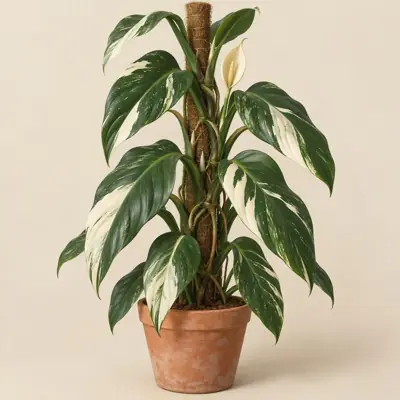
Few sources indicate a mature height of about 100–150 cm and a mature spread of about 50–100 cm. Juvenile leaves are lance-shaped, leathery, with a nearly heart-shaped to truncate base and an acuminate tip, and lack perforations; mature leaves are lance-ovate to lance-shaped and leathery, with a cuneate, rounded, or truncate base, usually entire with few perforations and occasionally shallowly pinnately lobed. The inflorescences are reported to arise from the leaf axils; the spathe changes from yellow-green during development to cream-yellow with brown spots outside and cream-white inside at flowering, while the spadix changes from white to cream-yellow. It is reported that the spathe may persist during fruiting; developing berries have green stylar caps, mature berries are moss green with gray pulp, and the seeds are brown with dark spots and oblong.
Light
It is reported to grow in bright indirect light to partial shade.
Watering
It is reported to need watering during growth with the medium kept moist but well drained, while in winter it should be kept only slightly moist and not persistently wet.
Humidity and airflow
It is reported to prefer high humidity.
Temperature and dormancy
Its RHS hardiness classification is reported as H1B.
Growing medium and mounting
It is reported to require a moist but well-drained medium; RHS lists chalk, clay, loam, and sand, with acidic, neutral, and alkaline conditions all considered suitable. For greenhouse or indoor cultivation, a peat-free, loam-based potting medium is recommended. Monstera standleyana has aerial and soil roots.
Feeding
A balanced liquid fertilizer is reported to be suitable during the growing period, applied regularly.
Propagation
It is reported to be propagated by seed, root-tip or leaf cuttings, and by layering during the warmer growing period.
Common problems
It is reported to be susceptible to scale insects and greenhouse red spider mites. RHS reportedly notes no significant disease problems. A sheltered setting is reported to be suitable, and its RHS hardiness classification is H1B.
Identification
Reported distinguishing features include dark green petioles, petiole sheaths extending nearly their full length with persistent, slightly wavy wings, leaves that are usually entire and without perforations, leathery spathes that are yellow outside and wither without falling, and moss-green infructescences.