
maidenhair vine (Muehlenbeckia complexa)
Muehlenbeckia complexa is a climbing or creeping perennial with slender, wiry, highly interwoven stems that can twine around other plants or form shrubby, ground-covering, or trailing growth. Sources differ in describing it as deciduous or semi-deciduous.
Overview
Muehlenbeckia complexa is a climbing or creeping perennial with slender, wiry, highly interwoven stems that can twine around other plants or form shrubby, ground-covering, or trailing growth. Sources differ in describing it as deciduous or semi-deciduous.
Origin and habitat
Sources differ on the native range: New Zealand is the core native area, while some compilations also include Australasia or Australia. It occurs along coasts, in lowlands, low-elevation mountain forests and forest edges, and in open and rocky habitats; introduced populations are also recorded in human-modified or urban environments. It is adapted to coastal and mild climates and tolerates sea winds and salt-laden winds, but not severe frost.
Characteristics
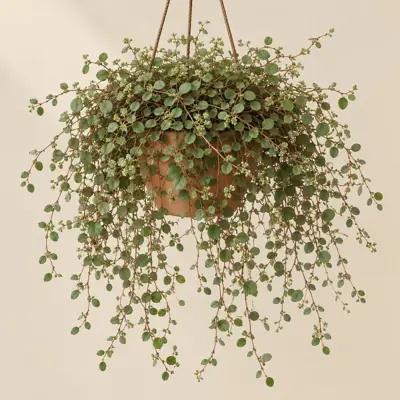
Sources differ on mature height, placing it at about 250–500 cm. A single source reports a mature spread of about 150–250 cm, so sources are few. The leaves are small, dark green, and variable in shape, including nearly round, heart-shaped, oblong, broadly obovate, or fiddle-shaped forms, and leaf shape can vary on the same plant. The small green to greenish-white flowers occur in short spikes or inflorescences at branch tips and leaf axils; plants are dioecious, and the flowers are also described as fragrant; flowering is reported to occur in autumn, while on female plants the perianth enlarges during fruiting into a glossy, waxy, white to translucent fleshy structure surrounding a black, glossy seed or nutlet-like fruit.
Light
It grows in full sun to partial shade and needs bright light when grown indoors.
Watering
Provide moderate water, keeping the growing medium moderately moist but well drained; avoid prolonged drying out, and water again after the surface has dried.
Humidity and airflow
It is reported to need good airflow.
Temperature and dormancy
A single source reports a minimum temperature of about -5 °C, so sources are few. Hardiness classifications are reported in both USDA and RHS systems. It is generally frost tender; keep above freezing.
Growing medium and mounting
It prefers light, permeable, well-drained soil and can grow in loamy, sandy, or calcareous soil with acidic, neutral, or alkaline pH.
Propagation
It can be propagated by seed or cuttings; semi-ripe shoots can be used for summer cuttings, mature shoots from the current year for autumn cuttings, and layering with rooting before separation is another method.
Common problems
Its stems can quickly twine around nearby plants or supports, requiring pruning to control their spread. It tolerates sea winds and salt-laden winds but is sensitive to severe frost and freezing, and strong frost can kill the above-ground growth. Possums are reported to feed on plants of the genus Muehlenbeckia.
Identification
Muehlenbeckia complexa is distinguished by masses of slender, tough, wiry branches that interweave densely, together with small, variably shaped leaves; the branches can creep or twine as they climb.
Photos


Sources
- Wikipedia (en): Muehlenbeckia complexa — CC BY-SA 4.0 · link
- Wikipedia (fr): Muehlenbeckia complexa — CC BY-SA 4.0 · link
- Wikipedia (es): Muehlenbeckia complexa — CC BY-SA 4.0 · link
- GBIF descriptions: Manual of the Alien Plants of Belgium; DAISIE - Inventory of alien invasive species in Europe; Globa — per dataset · link
- Wikipedia (nl): Muehlenbeckia complexa — CC BY-SA 4.0 · link
- Useful Tropical/Temperate Plants: Muehlenbeckia complexa — CC BY-NC-SA 3.0 (facts only) · link
- RHS Plants: Muehlenbeckia complexa — © RHS, facts only · link
- USDA PLANTS Database: Muehlenbeckia complexa — Public domain (US Government work) · link
- NC State Plant Toolbox: Muehlenbeckia (genus-level) — copyright (facts only) · link
- Top Tropicals catalog: Muehlenbeckia complexa — © Top Tropicals LLC (facts only) · link