
orange jasmine (Murraya paniculata)
Murraya paniculata is a perennial evergreen woody plant that grows as a shrub or small tree.
Overview
Murraya paniculata is a perennial evergreen woody plant that grows as a shrub or small tree.
Origin and habitat
Sources differ on the native range, which is described as spanning South Asia, southern East Asia, and Southeast Asia, extending east to Taiwan, the Ryukyu Islands, the Philippines, and parts of the Pacific islands, and south through Malaysia, Indonesia, New Guinea, and parts of Australia; TaiCOL lists it as native to Taiwan. It occurs in scrub, tropical rainforest understory, vine thickets, open or dense montane forest, hills, and near-coastal environments. It is suited to warm tropical to subtropical climates and prefers warm, relatively moist conditions.
Characteristics
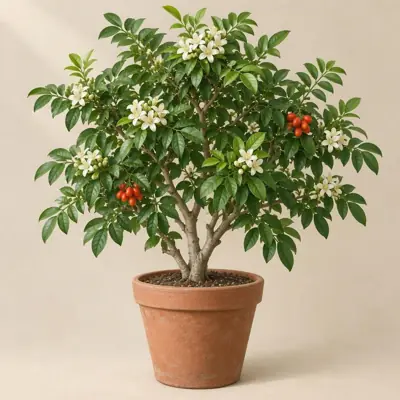
Sources differ on mature height, placing it at about 180–1200 cm. Growth is generally slow overall, although seedlings may grow faster early on before slowing. Sources differ in details of the foliage: the leaves are alternate and odd-pinnate, with usually glossy, entire leaflets ranging from ovate and elliptic to nearly rhombic, and crushed leaves can release a citrus-like rue-family scent. The strongly fragrant flowers are white to cream-white and are often borne terminally or in leaf axils in small clusters; sources differ on flowering patterns, while the fruit is an ovate to narrowly elliptic berry that changes from green when unripe to orange, orange-red, or vermilion when mature, with seeds that may be hairy.
Light
It can grow in full sun, partial sun, or bright conditions, and in cultivation it can be placed in ample sunlight while also adapting to light shade.
Watering
It prefers ample moisture and moist but well-drained soil; commercial horticultural sources also describe moderate watering after the surface soil dries and some tolerance of dry soil.
Humidity and airflow
It is reported to prefer high humidity and to need good airflow.
Temperature and dormancy
Sources are few and differ on the minimum temperature, placing it at around -4 °C. With few sources available, an ideal temperature of about 20–28 °C is reported. A USDA hardiness classification is reported, and the plant is reported to tolerate brief light frost.
Growing medium and mounting
It adapts to a broad range of soils, from acidic to alkaline and including clay, sand, and loam; fertile, moist, well-drained loam is considered more suitable in cultivation.
Feeding
It is reported that organic fertilizer can be supplied during vigorous spring and summer growth, while phosphorus and potassium fertilizer can accompany pruning to encourage new shoot growth.
Propagation
It can be propagated by seed, cuttings, and air layering, with seed propagation described as easy and capable of producing many seedlings quickly. Seeds taken from mature red berries can be cleaned of pulp and sown fresh in warm, moist conditions; drying or prolonged storage reduces germination rates.
Common problems
Potential pests include aphids, longhorn beetle larvae, mealybugs, and armored scale insects. Aphid damage is reported to be associated with sooty mold, while some sources describe the plant as generally less prone to disease. Armored scale is reported to be more likely on aging plants or where airflow is poor; pruning and improving airflow and light can reduce the problem. It favors warmth and does not tolerate severe cold; it can withstand occasional light frost, but protection from freezing is needed in cold areas, and strong winds are best avoided.
Identification
Murraya paniculata has a dense evergreen form, glossy pinnate leaves, strongly fragrant white flowers, and small berries that become orange-red to red when mature; the bark is generally pale and relatively smooth.
Photos


Sources
- Wikipedia (en): Murraya paniculata — CC BY-SA 4.0 · link
- 維基百科:月橘 — CC BY-SA 4.0 · link
- Wikipedia (ja): ゲッキツ — CC BY-SA 4.0 · link
- Wikipedia (de): Orangenraute — CC BY-SA 4.0 · link
- Wikipedia (fr): Murraya paniculata — CC BY-SA 4.0 · link
- Wikipedia (es): Murraya paniculata — CC BY-SA 4.0 · link
- GBIF descriptions: Captura y almacenamiento de carbono en el arbolado del Jardín Botánico de Bogotá José Celestino Muti — per dataset · link
- TaiCOL 臺灣物種名錄: Murraya paniculata — CC BY 4.0 · link
- 農業知識入口網 植物圖鑑: Murraya paniculata — © MOA, facts only · link
- Useful Tropical/Temperate Plants: Murraya paniculata — CC BY-NC-SA 3.0 (facts only) · link
- USDA PLANTS Database: Murraya paniculata — Public domain (US Government work) · link
- Top Tropicals catalog: Murraya paniculata — © Top Tropicals LLC (facts only) · link