
edible banana (Musa acuminata)
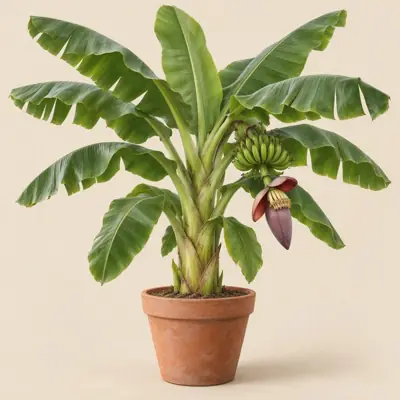
Musa acuminata is a large evergreen perennial herb with tightly overlapping leaf sheaths that form a non-woody pseudostem, giving it a tree-like appearance.
Overview
Musa acuminata is a large evergreen perennial herb with tightly overlapping leaf sheaths that form a non-woody pseudostem, giving it a tree-like appearance.
Origin and habitat
Sources differ on its native range, describing it as extending from southern Asia into Southeast Asia, including the Indian subcontinent, Indochina, southern China, Malaysia, Indonesia and the Philippines, with some accounts also including Sri Lanka and Australasia. Wild plants occur in shaded, moist valleys and ditches, swamps, semi-swampy areas and moist slopes, across a broad range of elevations. It is suited to moist to highly humid tropical and subtropical climates, prefers warmth and does not tolerate frost.
Characteristics
Sources differ on mature height, placing it at about 300–900 cm. Sources differ in their descriptions of leaf size; the leaves are large, simple, oblong to elliptic and tender in texture, usually green and sometimes reddish or purple underneath. Sources differ somewhat in describing the inflorescence, which emerges from the pseudostem and may be horizontal, angled or pendent; a single inflorescence bears both female and male flowers that are white to yellowish white, with reddish-purple bracts. The fruit is botanically a berry; wild forms have relatively slender fruits with many seeds, while cultivated forms are often triploid and parthenocarpic, producing nearly seedless bananas, and the Cavendish group is a common dessert-banana cultivated form; growth is rapid.
Light
Musa acuminata grows best in full sun, tolerates partial shade and can accept filtered light during hot periods.
Watering
During active growth it needs regular watering and moist but well-drained soil; the soil should not dry out completely, although some sources recommend watering after the surface has dried slightly.
Humidity and airflow
It is reported to prefer high humidity and needs little air movement.
Temperature and dormancy
Sources differ on the lower temperature guidance, which is about 12 °C. With few sources available, an ideal range of about 23–33 °C and an upper temperature of about 42 °C are reported. Sources differ on the stated hardiness zone. It is frost tender; keep above freezing.
Growing medium and mounting
It prefers soil rich in organic matter that is moist and well drained.
Feeding
Regular feeding during the growing period is generally recommended.
Propagation
It is reported to produce many suckers from underground or surface rhizomes, and triploid hybrids or cultivars are propagated mainly through these suckers.
Common problems
Large leaves are easily damaged by strong winds, while low temperatures and frost can injure the plant; direct exposure of the large leaves to strong winds should be avoided.
Identification
Musa acuminata is not a woody tree but a large herb whose enormous leaves and overlapping leaf sheaths form pseudostems; perennial underground or near-surface rhizomes or rhizome-like structures can produce clumps of pseudostems.
Photos


Sources
- GBIF Backbone: Musa acuminata Colla — CC BY 4.0 · link
- Wikipedia (en): Musa acuminata — CC BY-SA 4.0 · link
- 維基百科:小果野蕉 — CC BY-SA 4.0 · link
- Wikipedia (ja): マレーヤマバショウ — CC BY-SA 4.0 · link
- Wikipedia (de): Musa acuminata — CC BY-SA 4.0 · link
- Wikipedia (fr): Musa acuminata — CC BY-SA 4.0 · link
- Wikipedia (es): Musa acuminata — CC BY-SA 4.0 · link
- GBIF descriptions: The checklist of alien seed plants of D.R. Congo, based on evidence from herbarium collections; Chec — per dataset · link
- NC State Plant Toolbox: Musa acuminata — copyright (facts only) · link
- Wikipedia (it): Musa acuminata — CC BY-SA 4.0 · link
- Wikipedia (ko): 무사 아쿠미나타 — CC BY-SA 4.0 · link
- TaiCOL 臺灣物種名錄: Musa acuminata — CC BY 4.0 · link
- Useful Tropical/Temperate Plants: Musa acuminata — CC BY-NC-SA 3.0 (facts only) · link
- USDA PLANTS Database: Musa acuminata — Public domain (US Government work) · link