
Buddha's-lamp (Mussaenda philippica)
Sources differ in describing Mussaenda philippica as an evergreen shrub to small tree or as a semi-climbing evergreen shrub. It is described as perennial, although the evidence is conflicting.
Overview
Sources differ in describing Mussaenda philippica as an evergreen shrub to small tree or as a semi-climbing evergreen shrub. It is described as perennial, although the evidence is conflicting.
Origin and habitat
Accounts differ, but the Philippines is given as the core native range, and 'Dona Aurora' is reported to have first been found near Mount Makiling on Luzon. It is associated with tropical to warm conditions and cultivation where frost is absent or protection from frost is possible.
Characteristics
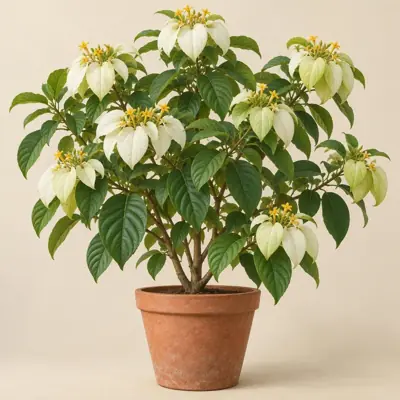
Sources differ on mature height, giving a range of about 100–800 cm. The opposite green leaves range from roughly elliptic and ovate to obovate, with entire margins and prominent veins; they may be softly hairy, especially along the veins beneath. 'Dona Aurora' is reported to have all calyx lobes enlarged and petal-like, creamy white to greenish white above with conspicuous greenish-white veins beneath; after flowering they become greener, slightly curved, and softer and drooping, while the true corolla of the species is narrowly funnel-shaped to tubular and has lobes in yellow to orange-yellow tones. The fruit is reported to be nearly round to elliptic, berry-like, slightly warty, many-seeded, brown when mature, and variably hairy.
Light
It is reported to grow in full sun to partial sun; ample sunlight favors flowering and coloration of the petal-like calyx lobes, while some midday shade can be provided in hot climates.
Watering
Regular watering is generally recommended, keeping the growing medium consistently moist while allowing the surface to dry slightly before watering again.
Humidity and airflow
It is reported to need little air movement.
Temperature and dormancy
Sources differ on the minimum temperature, with the limited information indicating about -1.1 °C. It is generally described as frost tender; keep above freezing.
Growing medium and mounting
A well-drained potting medium is generally recommended while maintaining moderate, consistent moisture.
Propagation
It can be propagated from cuttings, and sources also mention taking cuttings in late summer for overwintering.
Common problems
In indoor cultivation, spider mites and whiteflies are reported concerns, including when plants are overwintered indoors. No particularly serious disease problems are reported. Cold and frost can cause problems; the plant is sensitive to frost and freezing and is also less tolerant of strong winds, so a sheltered outdoor position is preferred.
Identification
Sources differ, but 'Dona Aurora' is distinguished by multiple or all calyx lobes becoming large and petal-like, mainly creamy white to greenish white, whereas the typical form of Mussaenda philippica usually has only a single notably enlarged calyx lobe.
Photos


Sources
- Wikipedia (en): Mussaenda philippica — CC BY-SA 4.0 · link
- Wikipedia (ja): ムッサエンダ・フィリピカ — CC BY-SA 4.0 · link
- Wikipedia (de): Mussaenda philippica — CC BY-SA 4.0 · link
- USDA PLANTS Database: Mussaenda philippica — Public domain (US Government work) · link
- Top Tropicals catalog: Mussaenda philippica — © Top Tropicals LLC (facts only) · link