
Pheasant's-eye Daffodil (Narcissus poeticus)
Narcissus poeticus is a perennial bulbous herb.
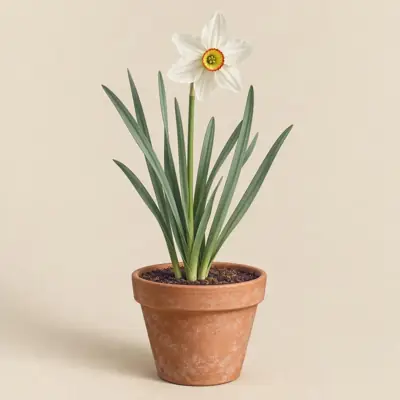
Overview
Narcissus poeticus is a perennial bulbous herb.
Origin and habitat
Narcissus poeticus is native to Europe, principally across central, southern, southwestern, southeastern, and parts of eastern Europe, although sources differ in their accounts of its native range. It occurs in mountain grasslands, moist meadows, and seasonally wet grasslands; records also include woodland edges, woodlands, scrub, and cultivated habitats. It is adapted to European mountain and moist-grassland environments and can experience wetter conditions during its growing period.
Characteristics
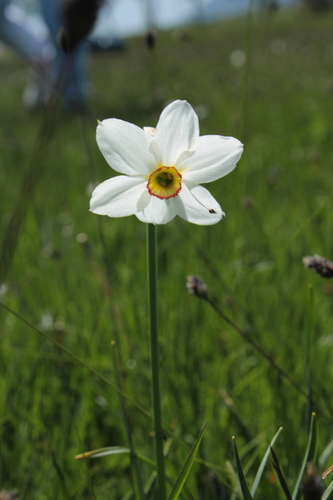
Sources differ on mature height, reporting about 20–60 cm. The leaves are linear and somewhat blue-green, according to a source. Sources differ in their descriptions of the flowers, which are strongly fragrant and usually solitary, with white to creamy-white perianth segments and a short pale-yellow to yellow corona with a conspicuous red margin. Flowering occurs in spring, with some sources describing it as mid-spring.
Light
It is reported to grow in full sun to partial sun.
Watering
It prefers moist conditions and soil that remains moist but well drained; wetter soil is tolerated during winter and spring growth, while reduced moisture is more suitable in summer and autumn.
Temperature and dormancy
A single source reports a minimum temperature of about -5 °C; sources are few.
Growing medium and mounting
It prefers moist, well-drained, organic-rich soil; some sources also indicate that it can adapt to heavier soils and favors moist conditions with little lime.
Propagation
It can be propagated vegetatively from offsets or by seed. Seed is suited to sowing soon after maturity; short stratification of stored seed can improve germination, and young seedlings can initially be grown in containers before being separated to develop their bulbs.
Common problems
It is reported to be susceptible to damage from slugs, snails, bulb mites, and narcissus bulb flies. It is adapted to moist conditions during growth and relatively drier conditions in summer and autumn; sources also report some tolerance of heat and drought in the plant and cold soil in dormant bulbs.
Identification
Narcissus poeticus has white perianth segments surrounding a short yellow to pale-yellow corona with a conspicuous red margin; its strongly fragrant flowers are usually solitary.
Photos


Sources
- Wikipedia (en): Narcissus poeticus — CC BY-SA 4.0 · link
- 維基百科:红口水仙 — CC BY-SA 4.0 · link
- Wikipedia (de): Weiße Narzisse — CC BY-SA 4.0 · link
- Wikipedia (fr): Narcisse des poètes — CC BY-SA 4.0 · link
- Wikipedia (es): Narcissus poeticus — CC BY-SA 4.0 · link
- GBIF descriptions: Manual of the Alien Plants of Belgium; Database of Vascular Plants of Canada (VASCAN); DAISIE - Inve — per dataset · link
- NC State Plant Toolbox: Narcissus poeticus — copyright (facts only) · link
- Useful Tropical/Temperate Plants: Narcissus poeticus — CC BY-NC-SA 3.0 (facts only) · link
- USDA PLANTS Database: Narcissus poeticus — Public domain (US Government work) · link