
cream narcissus (Narcissus tazetta)
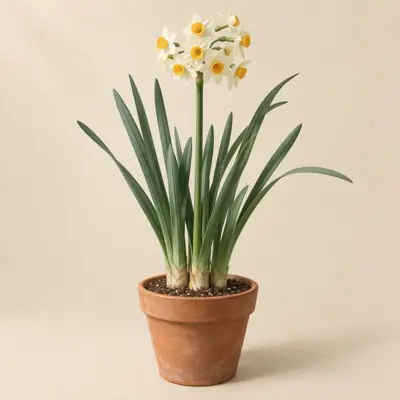
Narcissus tazetta is a bulbous perennial herb that grows from an underground bulb.
Overview
Narcissus tazetta is a bulbous perennial herb that grows from an underground bulb.
Origin and habitat
Narcissus tazetta is mainly native to the Mediterranean region, including southern Europe and North Africa, and extends into Asia, although sources differ on the limits of its native range in Asia. Its habitats include fields, grasslands, scrub, riverbanks, and Mediterranean-type shrub vegetation, particularly moister sites; it is also recorded from peatlands, marshes, and wetland habitats.
Characteristics
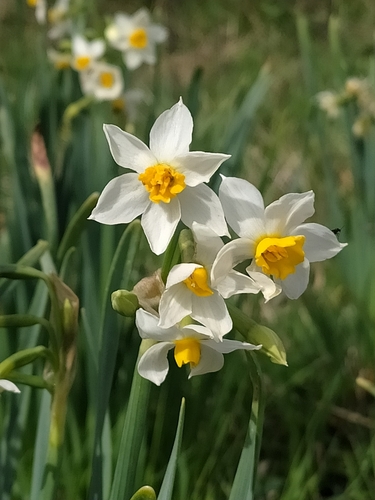
Sources differ on mature height, placing it at about 20–80 cm. The leaves are narrow, linear to broadly linear, and flat, sometimes slightly grooved and often upright; some sources describe them as blue-green. Sources differ in their descriptions of the fragrant flowers, which are borne several together in umbel-like or nearly umbel-like inflorescences, with mainly white, cream-white, or yellow perianths and a cup-shaped yellow or orange corona. Flowering occurs from winter to spring, while the fruit is reported to be an elongated to ovoid capsule with ovoid, glossy black seeds.
Light
Narcissus tazetta grows in full sun to partial sun, with warm, sunny positions sheltered from cold winds being more suitable.
Watering
During active growth, keep the soil evenly moist but well drained; during dormancy, the plant tolerates drier conditions, and prolonged excessive moisture should be avoided. For ornamental cultivation in water, the base of the bulb can be kept in contact with water and the water changed regularly.
Growing medium and mounting
Narcissus tazetta adapts to various soils, including heavier clay, while preferring a deep, well-drained medium; sources also indicate a preference for alkaline soil.
Feeding
When planted in soil, bone meal or superphosphate may be added to the planting hole. For short-term flowering of bulbs in water, fertilizer may be omitted because the bulb stores nutrients.
Propagation
Narcissus tazetta can be propagated by seed or offsets, with vegetative propagation accomplished by separating offsets formed around the parent bulb. Chinese narcissus cultivated forms are highly sterile and are propagated mainly by offsets.
Common problems
Reported pests include slugs, snails, bulb mites, and narcissus bulb flies. Excessively wet soil is unfavorable for growth, and in warm lowland environments the bulbs of Chinese narcissus are prone to rot while passing the summer after flowering. Warm locations sheltered from cold winds are preferred, but sources differ on cold tolerance: one describes the species as not cold-hardy, while another indicates that dormant bulbs can withstand some subfreezing soil temperatures.
Identification
Narcissus tazetta can be recognized by its underground bulb, narrow flat leaves, clustered many-flowered inflorescences, and fragrant flowers with white to cream-white perianths and a cup-shaped yellow or orange corona.
Photos



Sources
- Wikipedia (en): Narcissus tazetta — CC BY-SA 4.0 · link
- 維基百科:多花水仙 — CC BY-SA 4.0 · link
- Wikipedia (ja): スイセン — CC BY-SA 4.0 · link
- Wikipedia (de): Strauß-Narzisse — CC BY-SA 4.0 · link
- Wikipedia (fr): Narcissus tazetta — CC BY-SA 4.0 · link
- Wikipedia (es): Narcissus tazetta — CC BY-SA 4.0 · link
- GBIF descriptions: Manual of the Alien Plants of Belgium; DAISIE - Inventory of alien invasive species in Europe; Globa — per dataset · link
- NC State Plant Toolbox: Narcissus tazetta — copyright (facts only) · link
- 農業知識入口網 植物圖鑑: Narcissus tazetta — © MOA, facts only · link
- Useful Tropical/Temperate Plants: Narcissus tazetta — CC BY-NC-SA 3.0 (facts only) · link
- USDA PLANTS Database: Narcissus tazetta — Public domain (US Government work) · link