
sacred lotus (Nelumbo nucifera)
Nelumbo nucifera is a perennial rhizomatous aquatic herb whose leaves and flowers can rise above the water, with underground rhizomes growing in bottom mud.
Overview
Nelumbo nucifera is a perennial rhizomatous aquatic herb whose leaves and flowers can rise above the water, with underground rhizomes growing in bottom mud.
Origin and habitat
Sources differ on its native range: it is broadly native across Asia, including western Asia, the Indian subcontinent, China, East Asia, Indochina and Southeast Asia, while some accounts also include Australia or Oceania. It inhabits freshwater and adjoining areas, including ponds, lakes, marshes, slow-flowing parts of rivers and deltas, with its rhizomes growing in submerged mud or loamy mud. It favors a warm to hot growing season and can grow in tropical and subtropical climates as well as cooler regions with hot growing seasons; parts of its distribution also extend to relatively high elevations.
Characteristics
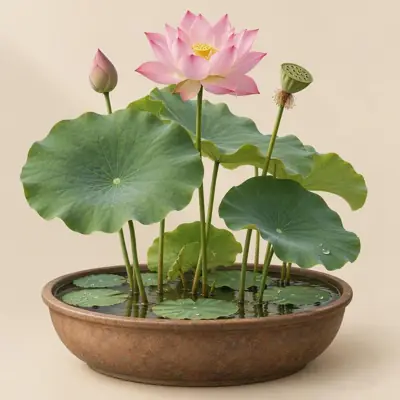
Mature plants reach 100–150 cm in height; sources differ on spread, with limited evidence suggesting about 100–150 cm. The large, round to nearly round, peltate leaves have long petioles, may float or rise above the water, and have a strongly water-repellent surface. Large, fragrant, solitary flowers are borne on long stalks above the water; they are mainly pink or white, while cultivated forms can have other flower colors, and flowering is mainly in summer, although sources differ on whether it can extend from late spring into autumn under some regional or cultivation conditions. After flowering, a receptacle with multiple cavities forms, with nut-like fruits embedded within it, as reported by a single source.
Light
Nelumbo nucifera grows in full sun, with a position sheltered from strong winds and heavy wave action preferred.
Watering
As an aquatic plant, its rhizomes need to remain in submerged soil within an aquatic environment; sources differ in their recommendations for water depth.
Temperature and dormancy
Few-source evidence reports a lower temperature value of about -5 °C and an upper value of about 40 °C.
Growing medium and mounting
The rhizomes are suited to fertile loam, heavy loam or silty soil underwater; RHS specifies loam that may be mixed with well-rotted organic matter.
Feeding
The growing medium can be an organic-rich loam, and RHS recommends adding well-rotted farmyard manure or compost to heavy loam.
Propagation
Propagation can be by seed or rhizome, including division of rhizome sections; the hard seed coat can be broken before sowing under warm conditions, and tissue culture is also mentioned by a source.
Common problems
Aphids are reported to damage flowers and leaves. It is reported that an undersized container or restricted runner growth can result in smaller plants, reduced petals and leaves, poor flowering or reduced fruiting, while overly vigorous populations may displace other aquatic organisms. New growth is sensitive to frost and can be severely damaged by relatively mild freezing conditions; sheltered locations with little wave action are preferred, and underground rhizomes require overwintering attention in cold regions.
Identification
The petiole of each round, peltate leaf attaches near the center of the blade, mature leaves commonly rise above the water, and large flowers likewise stand above the water before forming a receptacle with cavities after flowering. The markedly water-repellent leaf surface helps distinguish Nelumbo nucifera from water lilies, whose leaves typically lie close to the water surface.
Photos


Sources
- Wikipedia (en): Nelumbo nucifera — CC BY-SA 4.0 · link
- 維基百科:莲 — CC BY-SA 4.0 · link
- Wikipedia (ja): ハス — CC BY-SA 4.0 · link
- Wikipedia (de): Indische Lotosblume — CC BY-SA 4.0 · link
- Wikipedia (fr): Nelumbo nucifera — CC BY-SA 4.0 · link
- Wikipedia (es): Nelumbo nucifera — CC BY-SA 4.0 · link
- GBIF descriptions: Database of Vascular Plants of Canada (VASCAN); Checklist of introduced taxa in Romania; An updated — per dataset · link
- NC State Plant Toolbox: Nelumbo nucifera — copyright (facts only) · link
- 農業知識入口網 植物圖鑑: Nelumbo nucifera — © MOA, facts only · link
- Useful Tropical/Temperate Plants: Nelumbo nucifera — CC BY-NC-SA 3.0 (facts only) · link
- RHS Plants: Nelumbo nucifera — © RHS, facts only · link
- USDA PLANTS Database: Nelumbo nucifera — Public domain (US Government work) · link