blushing bromeliad (Neoregelia carolinae)
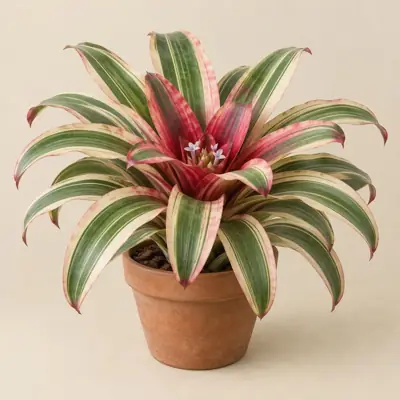
Neoregelia carolinae is an evergreen, rosette-forming epiphyte whose leaves form a central tank that can hold water. It is perennial; after an individual rosette flowers, the mother plant gradually dies while basal offsets continue the growth.
Overview
Neoregelia carolinae is an evergreen, rosette-forming epiphyte whose leaves form a central tank that can hold water. It is perennial; after an individual rosette flowers, the mother plant gradually dies while basal offsets continue the growth.
Origin and habitat
Sources differ on its native range: it is described as native to Brazil, while one source more specifically describes it as endemic to the Bahia region of Brazil. It occurs in tropical to subtropical environments.
Characteristics
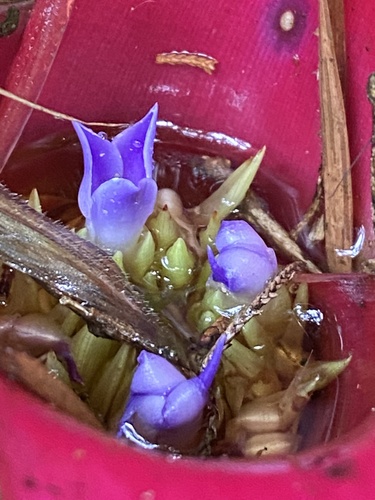
Sources differ on mature height, with the limited information placing it at about 30–30 cm, while the few available figures for mature spread are about 5.08–91.44 cm. The leaves form a rosette and commonly have spiny or serrated margins; in Neoregelia carolinae they are green, leathery, and lance-shaped, with the bases of the inner leaves turning red before flowering. The flowers are reported to be small, borne within the central tank of the rosette, and purple to pale purple. Flowering is reported to last for an extended period, though the source does not give specific months.
Light
It needs bright light throughout the year to maintain good leaf color, but strong direct sunlight that can scorch the leaves should be avoided.
Watering
From spring through autumn, water from above and fill the central tank, while allowing the potting medium to dry between waterings; during cold winter conditions, empty standing water from the tank.
Temperature and dormancy
It is reported to prefer a bounded temperature range, but the available claim does not provide a renderable numeric range. It is generally frost tender; keep above freezing. A cold minimum is reported, but the claim does not provide a renderable numeric value.
Growing medium and mounting
Use a well-drained epiphytic medium such as sphagnum moss, coconut husk, or a bark-based orchid potting medium. The preferred growing arrangement is potted.
Feeding
During the spring-to-autumn growing period, slow-release chemical fertilizer is reported to be applied periodically.
Propagation
Propagation is by separating basal offsets; sources recommend separating sufficiently developed offsets during warmer conditions and avoiding cold periods, with another source using the offset's size relative to the mature plant as the criterion for separation and planting.
Common problems
Potential pests include scale insects, spider mites, and mealybugs. Potential problems include anthracnose, leaf blight, leaf spot, and root or crown rot associated with overwatering. Insufficient light is reported to fade leaf color, strong direct sunlight may scorch leaves, overwatering may cause root or crown rot, and standing water in outdoor tanks may become a mosquito breeding site. It is reported to have weak cold tolerance and strong heat tolerance, and the central tank should not remain filled with water during cold conditions.
Identification
Before flowering, the center of the rosette and nearby leaves turn conspicuously red, while the inflorescence sits within the central water-holding tank near the water surface.
Photos